
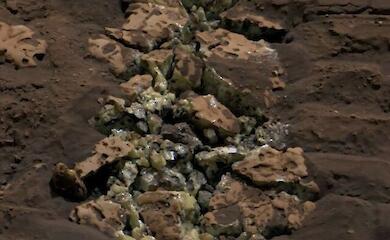
Traces of an ancient salty world were found in a meteorite that crashed through the roof of a house


In July 2024, a meteor flew over New York with a sonic boom, and one of the surviving fragments pierced the roof of a residential building in Hillsborough, New Jersey. The space debris scattered across the bedroom, leaving a hole in the ceiling, black dust and a pungent smell reminiscent of sulphur.
Scientists have now discovered that this rock preserves a much more ancient history. Inside it, they found traces of exposure to concentrated brines that existed on the parent asteroid billions of years ago.
These liquids may have played a part in the formation of complex organic compounds, including amino acids. However, no traces of life were found in the meteorite: we are talking about chemical processes that preceded the emergence of living organisms.
Space rock pierced the roof of a house
On 16 July 2024, a daytime meteor flew past the Statue of Liberty. It was observed by dozens of people in New York and neighbouring states, and some felt the shockwave it caused.
The meteor entered the atmosphere at a speed of around 14.4 kilometres per second — that is more than 50,000 kilometres per hour. It broke up in flight, forming a long trail of debris which was later tracked using weather radars.
One of the largest fragments fell onto a house in Hillsborough. It pierced the roof and the ceiling of the master bedroom, split on impact and scattered across the bed, the carpet and surrounding objects.
The homeowner quickly collected the fragments in glass containers, using disposable gloves and aluminium foil. Thanks to this, the samples were almost entirely free from terrestrial contamination and proved particularly valuable to researchers.
The meteorite turned out to be extremely rare
Analysis showed that the Hillsborough meteorite belongs to the CM-type carbonaceous chondrites — ancient and chemically primitive rocks that formed during the early stages of the Solar System’s history.
The letter ‘M’ in the name of this group derives from the Migei meteorite, which fell in 1889 in what is now Ukraine.
The specimen from New Jersey has been given an intermediate classification of CM1/2. This means that its rocks have been subjected to greater water exposure than most CM2-type meteorites, but are better preserved than CM1-type specimens that have been completely altered by water.
Hillsborough was only the second recorded fall of a meteorite of this rare intermediate type. The first was the Kolang meteorite, which fell in Indonesia in 2020.
What does ‘ancient salty world’ mean?
This does not refer to a planet with oceans, nor to a world literally covered in salt.
The meteorite was part of a small primordial asteroid. At some point, liquid water existed inside or near the surface of this body, interacting with the rock. As it evaporated, the solution became increasingly saturated with salts.
Scientists have discovered small fragments within the meteorite that have been altered by such concentrated brines. These may have formed in the near-surface region of the asteroid, where water evaporated and dissolved substances accumulated.
Similar processes had previously been studied in detail in samples from the asteroids Ryugu and Bennu, which were brought to Earth by space probes. However, such clear evidence of concentrated brines had not previously been observed in the parent bodies of CM1/2 meteorites.
Why brines have caught scientists’ attention
Concentrated salt solutions can create specific conditions for chemical reactions.
For example, they help certain compounds, including phosphates, to remain dissolved for longer. Brines are also capable of accelerating the interaction between organic substances and minerals.
Such an environment could have functioned as a natural chemical laboratory: water dissolved substances, evaporation increased their concentration, and minerals took part in new reactions.
Researchers are currently determining the exact composition of the salts found and comparing them with minerals from samples of the asteroids Ryugu and Bennu.
Amino acids were discovered inside
A variety of soluble organic compounds were found in the meteorite. These included amino acids, carboxylic acids and unusual molecules containing magnesium.
Amino acids are primarily known as components of proteins in living organisms. However, they can also form without the involvement of life — as a result of ordinary chemical processes in space and inside asteroids.
The chemical composition of the find indicates that the meteorite’s organic matter has been significantly altered by exposure to water. The authors suggest that some of the amino acids may have formed directly within the parent asteroid, including through the action of brines.
However, it is not yet known whether the magnesium-containing organic compounds arose as a result of these liquids or were preserved following earlier impact events.
Have scientists found any signs of extraterrestrial life?
No.
The presence of carbon, nitrogen, amino acids and other organic substances does not in itself indicate the existence of living organisms. In chemistry, the term ‘organic’ refers primarily to carbon compounds, many of which arise without any biological involvement.
The meteorite suggests something else: the complex molecules necessary for the further development of prebiotic chemistry could have formed on asteroids and been preserved within them for billions of years.
Such bodies subsequently fell onto the young Earth and delivered an additional supply of organic matter to its surface.
How the meteorite’s path was reconstructed
The researchers used footage from specialised cameras, doorbell CCTV and eyewitness accounts to reconstruct the meteor’s trajectory.
Calculations showed that its orbit led to the inner part of the main asteroid belt between Mars and Jupiter.
After the rock disintegrated in the atmosphere, the weather radar at Newark Airport detected a cloud of falling debris stretching from Staten Island to New Jersey. Hillsborough was situated at the far end of this area, where the largest fragments were expected to fall.
Most of the debris probably went unnoticed. One piece was recovered for study only because it had crashed through a residential house.
Why this is important
Meteorites of this type are virtually unaltered fragments of the early Solar System. They preserve information about the chemical processes that took place long before the Earth came into existence in its present form.
The discovery shows that even small asteroids may have had a complex history involving water. The water inside them not only altered the minerals but also created concentrated brines capable of influencing organic reactions.
This helps us understand where the amino acids and other molecules involved in prebiotic chemistry came from on the early Earth. The study does not solve the mystery of the origin of life, but it highlights one possible route by which its chemical building blocks might have been delivered.
Background
Carbonaceous chondrites are rare stony meteorites rich in carbon, water, organic compounds and the oldest minerals in the Solar System.
Many of them formed more than 4.5 billion years ago. Their parent asteroids were not large enough to become planets, but inside some of them, ice melted and reacted with the rock.
Samples from the asteroids Ryugu and Bennu have already shown that such small bodies could contain water, salts, amino acids and other organic compounds. The Hillsborough meteorite adds to this picture by providing evidence of the unusual chemistry of concentrated brines within a CM-type asteroid.
Source
Peter Jenniskens et al.“Meteor over New York City: Brines in a primitive CM asteroid”, Science Advances, 2026.
Mykola Potyka has a wide range of knowledge and skills in several fields. Mykola writes interestingly about things that interest him.
Related news
A scientist has proposed a way to preserve life on Earth after the Sun’s demise

Astronomers have determined just how large the Universe’s largest galaxy is
A new crater is set to form on the Moon – scientists will be watching it come into being
Ancient astronomers could see a star that was 12 times brighter than it is now
Popular news

Ukrainian security services have been recognised as among the best intelligence services in Europe – L'Express



Irina Levchenko, the abducted Ukrainian journalist, has been transferred to the Donetsk remand centre: what is known

Evidence has been found in Australia of an unusual ritual that has been practised for thousands of generations

News about war

The UN has reported a sharp rise in the number of Ukrainian civilians killed as a result of the war

3 July has been declared a day of mourning in Kyiv. The number of dead and injured is rising