


Scientists have discovered no fewer than seven new species of frog in Madagascar


An international team of researchers has described no fewer than seven new species of rhombophryne frogs (Rhombophryne) found in Madagascar. The discovery is the result of more than 12 years’ work, combining field expeditions, museum collections and modern DNA analysis techniques. The study revealed that one of the island’s most enigmatic groups of amphibians is in fact considerably more diverse than previously thought.
Rhombic frogs lead an extremely secretive lifestyle. They spend most of their time under fallen leaves, and many species look so similar to one another that it is virtually impossible to tell them apart.
According to the study’s lead author, Mark Scherz of the Natural History Museum of Denmark, scientists had long suspected the existence of unknown species, but have only now been able to confirm this.
Following the publication of the study, the number of known species in the genus Rhombophryne has increased from 20 to 27.
Details
One of the main difficulties was comparing modern finds with specimens described decades ago.
The breakthrough was achieved through so-called museomics — the sequencing of DNA from historical museum specimens. The genetic data was combined with an analysis of the frogs’ external structure, skeleton and mating calls.
It was this that made it possible to resolve the long-standing confusion and prove the existence of seven previously unknown species.
Why this is important
Most diamond-spotted frogs are found only in the forests of Madagascar, which continue to shrink rapidly due to deforestation.
At the same time, the biology of many species remains virtually unknown. Scientists do not yet know their population sizes, reproductive behaviour or ecological requirements, which seriously hinders the development of conservation measures.
The authors note that the study’s findings are already being used to plan the expansion of the network of specially protected natural areas as part of Madagascar’s biodiversity conservation programme.
Research continues
Despite the description of seven new species, the researchers are confident that this is far from the end.
In their view, the island’s remote forests are still home to other members of the genus Rhombophryne, which remain unknown to science.
Each new species represents millions of years of independent evolution and helps us to better understand the origins of Madagascar’s unique fauna.
Source
Study: Mark D. Scherz et al. A wealth of riches: A comprehensive revision of diamond frogs, genus Rhombophryne Boettger, 1880 (Microhylidae: Cophylinae), with the description of seven new species.
Journal: Vertebrate Zoology (2026).
Mykola Potyka has a wide range of knowledge and skills in several fields. Mykola writes interestingly about things that interest him.
Related news

Scientists have managed to restore an ageing liver to a partially youthful state

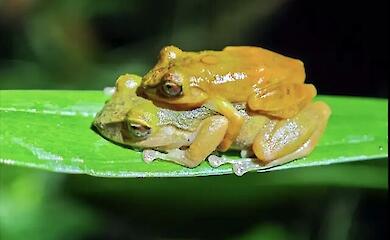
People have seen this frog thousands of times, but it is only now that they have realised it is a new species
Scientists tracked the whales — and recorded a speed almost twice the speed of sound
Birds don’t bring fresh plants to their nests for no reason — scientists have discovered a strange effect

Popular news

How to cook sweetcorn properly so that it’s juicy and sweet: the best method revealed


Archaeologists have discovered who actually built Colombia’s ancient canals


Russia has received new weapons from North Korea: which regions of Ukraine could be at risk

Bones of ancient humans found on the seabed of the Taiwan Strait suggest they were up to 190 cm tall
News about war


An expert explains how Russia is changing its tactics for strikes on Kyiv


The UN has reported a sharp rise in the number of Ukrainian civilians killed as a result of the war

