
A 2,500-year-old statue was found face down beneath an ancient road — it has been preserved almost in its entirety


Archaeologists investigating the ancient city of Sardis in western Turkey have discovered a monumental marble statue, some 2,500 years old, beneath a Roman street. It had once been broken into two large pieces and used as ordinary paving stones for the road, with the figure laid face down. Paradoxically, it was precisely this that helped to preserve the face and many of the sculpture’s fine details almost intact.
The figure depicts a young man and stands approximately 2.2 metres tall. Who he is, why the statue was created and where it originally stood remain unknown. The style of execution is also unusual: the clothing and hairstyle appear to be about a century older than some of the anatomical details. Archaeologists suggest that the artist deliberately drew on Sard’s past.
The enormous statue was discovered right in the pavement
The discovery was made in late May 2026 during an investigation of a large colonnaded street in ancient Sardis — a city near modern-day Salihli in the province of Manisa.
At first, the archaeologists noticed large blocks of marble embedded in the road surface. Gradual excavation revealed that this was not ordinary building material, but two parts of a human figure considerably taller than life-size.
The statue had been broken up and then reused in the construction of the Roman-period street. The pieces had been laid in such a way that the front side was facing the ground. On 13 July, experts finally lifted the fragments and transported them to a restoration laboratory.
The figure’s feet and a few small parts are missing, but otherwise the work has survived remarkably well.
The Turkish Ministry of Culture and Tourism describes it as one of the rare examples of monumental sculpture from the first half of the 5th century BC.
Lying face down saved the sculpture
For a statue, being turned into a paving stone sounds like the worst possible fate.
But archaeologically, the opposite proved to be true.
When a marble sculpture remains exposed for centuries or lies face-up, its surface is eroded by water, wind, temperature fluctuations, soil and physical damage.
Here, however, the most expressive part of the figure turned out to be protected.
The Turkish authorities directly attribute the good state of preservation of the facial features and other details to the fact that the statue was laid face-down when reused in the paving.
Thus, the ancient builders, probably without any intention of doing so, helped to preserve the artefact for 21st-century archaeologists.
Archaeologists date the statue to around 470–450 BC.
The find is around 2,500 years old, though this is not the result of laboratory analysis of the marble.
Researchers date the statue primarily on the basis of its artistic style. The most likely range is approximately 470–450 BC, that is, the early Classical period of Greek art.
But there is a curious problem with the statue.
If one looks at its pose, long, styled hair and clothing, the figure resembles much earlier Greek depictions from the 6th century BC.
At the same time, the hands, face and certain other parts of the body are rendered differently. For example, the sculptor emphasised the protruding veins – a detail characteristic of later art.
It turns out that the work was created in a single era, but part of its appearance—whether consciously or by tradition—refers back to a time roughly 100 years earlier.
The clothing proved to be one of the most unusual aspects of the find.
The figure wears a thin tunic – a chiton – over which a cloak is draped diagonally. Beneath it, another garment with very fine horizontal folds is visible.
According to Bahadır Yıldırım, deputy head of fieldwork, there are few direct parallels to this combination of details in ancient sculpture.
It is the clothing in particular that bears a strong resemblance to the earlier Lydian and Anatolian traditions.
In Greece, around the same period, young men were often depicted nude. In Lydia and other Anatolian societies, attitudes towards nudity were different, and local youths were traditionally depicted as clothed.
The result is an intriguing blend: the artist was familiar with the new artistic techniques of the Mediterranean, yet employed a significantly more ancient representation of the male figure.
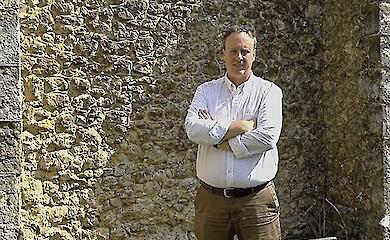
Excavation director Nicholas Cahill considers this to be one of the most significant features of the find.
According to his interpretation, the sculptor was well acquainted with the art of his own time — this is evident from the modelling of the face, hands and anatomical details. Yet at the same time, he deliberately employed the clothing and hairstyle of an earlier era.
This may be a kind of reference to Sardis’s Lydian past.
This interpretation is particularly interesting in light of the political situation.
By the time the statue is thought to have been created, Sardis had not been the capital of the independent Lydian kingdom for almost a century. Following the Persian conquest, the city became a major administrative centre of the Achaemenid Empire.
However, researchers do not yet see any obvious Persian artistic influence in the new figure.
This does not mean that the statue expressed resistance to the Persians or any particular political agenda. But its unusually old-fashioned appearance may reflect the inhabitants’ desire to preserve their own cultural tradition even after the disappearance of the independent state.
For now, this is an interpretation rather than an established fact.
The identity of this man remains unknown
Despite its good state of preservation, the statue has not answered the most obvious question.
Archaeologists do not know whom it depicts.
He may have been an influential resident of the city, a member of the local elite, or some other significant figure. But there is as yet no basis for giving the man a specific name or identifying him as a ruler, a priest or a hero.
Nor has the original location of the monument been established.
One theory under discussion links it to the sanctuary of Cybele — an important Anatolian mother goddess.
Ancient written sources mention a major sanctuary of Cybele in Sardis, but archaeologists have not yet discovered it.
If the statue did indeed stand there, it may have represented a human figure depicted alongside the deity as an eternal participant in worship. However, there is currently no direct evidence that the new figure originates specifically from the sanctuary of Cybele.
There is another mystery in the figure’s hand
Official photographs show that the man is holding a small object, which researchers interpret as a fruit.
Turkish experts suggest that this detail may have been linked to a religious offering. The object itself may also provide further information about who the statue depicted and the context in which it was originally used.
But here too, it is best not to jump to conclusions just yet.
Without an inscription or a precisely established archaeological context, a single fruit in his hand is not enough to identify the man or the specific deity to whom he might have been making an offering.
The statue was probably once coloured
Today, the figure looks like a typical white marble ancient sculpture.
But its original appearance may have been quite different.
Most ancient marble statues were painted. Restorers are therefore cleaning the surface with particular care, endeavouring to preserve any microscopic traces of ancient pigments.
If such residues are found, analysis will reveal the colours of the figure’s clothing, hair or other features.
Once the conservation work is complete, the plan is to join the two large sections together and display the find in an archaeological museum in Turkey.
Why the find is considered rare
The state of preservation itself is not the only reason for the interest.
Monumental marble statues from the first half of the 5th century BC are generally quite rare. It is even rarer for researchers to recover a virtually complete figure of this size from an Anatolian centre such as Sardis.
Kehill considers the monument to be an important new source for understanding Lydian art and how the city’s inhabitants perceived their own cultural past following political upheavals.
The context of the city itself is particularly important.
Sardis was the capital of the Lydian state — one of the most influential Iron Age civilisations in western Anatolia. The city was renowned for its wealth and played a key role in the early history of coinage. After the fall of Lydia, it continued to exist under Persian, Hellenistic, Roman and Byzantine rule.
In 2025, Sardis and the Lydian burial mounds at Bin Tepe were inscribed on the UNESCO World Heritage List.
But the main question remains: why was it cast aside?
The statue was clearly once a costly monument.
It took a large block of high-quality marble, a skilled sculptor and considerable effort to create a figure taller than a person. It probably stood in a prominent public or religious location.
And then its significance faded to such an extent that the work was smashed up and used as building material.
Why this happened is unknown.
Over the centuries, Sardis has seen changes in rulers, religions, social institutions and the urban landscape. The statue may have lost its significance following a reorganisation of the space, a change in religious practice or the demolition of the original building.
However, the current evidence does not allow us to pinpoint a single scenario.
Even the time when it was incorporated into the pavement cannot automatically be equated with the age of the statue itself. The figure was created around 2,500 years ago, whilst it was reused much later, during the Roman period.
And this is one of the most remarkable aspects of the discovery: the artefact outlived its own era, lost its original significance, became an ordinary stone under the feet of passers-by — and it is precisely because of this that, centuries later, it reached archaeologists almost intact.
Source
Full article: Sy Boles,“Mystery statue unearthed at Sardis archaeological dig”, Harvard Gazette, 24 August 2026.
An independent researcher, interested in archaeology and sacred geography. He researches them and writes about them.
Related news
Henry VIII’s long-lost castle has been found inside another castle

In Japan, enormous vessels were used for everything from cooking to burial — scientists have uncovered their history
Mysterious symbols have been found on 9,000-year-old arrowheads — no one understands what they mean
6,500 years ago, a human tooth was turned into a piece of jewellery — it was found in Serbia
Popular news

How to cook sweetcorn properly so that it’s juicy and sweet: the best method revealed


Archaeologists have discovered who actually built Colombia’s ancient canals

Russia has received new weapons from North Korea: which regions of Ukraine could be at risk
Bones of ancient humans found on the seabed of the Taiwan Strait suggest they were up to 190 cm tall

News about war


An expert explains how Russia is changing its tactics for strikes on Kyiv


The UN has reported a sharp rise in the number of Ukrainian civilians killed as a result of the war