
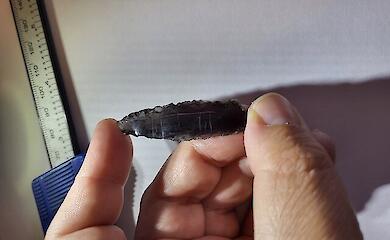

6,500 years ago, a human tooth was turned into a piece of jewellery — it was found in Serbia


Archaeologists have discovered that a small object, which had been held in the museum’s collection for almost two decades as an ornament made from an animal’s tooth, is in fact made from a human canine tooth.
Around 6,500 years ago, it was carefully crafted, drilled and, in all likelihood, suspended from a cord. Microscopic traces inside the hole indicate that the ornament was worn for a considerable period of time.
The find comes from the Late Neolithic site of Jablanița in Serbia and is associated with the Vinča culture. However, the age requires some qualification: the tooth itself has not been directly dated — it was found on the surface — so the estimate of approximately 6,500 years is based on the chronology of the site and the similarity of the working techniques to those used on another dated ornament.
Details
The object was discovered during fieldwork at the Neolithic settlement of Yablanitsa, south of Belgrade.
The small tooth, approximately 23 mm long, was lying on the surface of a field. It had been damaged during agricultural work: the crown had split into two pieces. The fragments ended up at the Mladenovac Museum, where the find was identified as a bead or pendant made from an animal’s tooth.
It remained in the collection under this classification for nearly two decades.
The situation changed when archaeologist Nemanja Marković from the Institute of Archaeology in Belgrade and Ana Maričić from the Belgrade City Museum re-examined the object. Anatomical features made it clear that they were looking at a human upper right canine.
The researchers used macroscopic and microscopic analysis, as well as X-ray imaging.
It turned out that the shape of the tooth had been deliberately altered. The tip of the root had been filed down, and a hole had then been drilled through it in a transverse direction. The authors consider these alterations to be unambiguously man-made — they cannot be explained by natural tooth decay.
Under the microscope, the scientists discovered traces of repeated friction inside the tooth. These correspond to the movement of an organic fibre — for example, a cord from which the object might have been suspended.
This is precisely why the researchers interpret the tooth not simply as a pierced human remains, but as a personal ornament, most likely a pendant.
Signs of wear suggest that the tooth was not made solely for burial or some kind of short-term ritual.
According to Markovich, the hole has been drilled with considerable precision, whilst the nature of the microscopic damage indicates that the object was in prolonged use. Crafting such a pendant required a certain degree of skill.
This is particularly interesting because jewellery is generally rare amongst finds from Yablitsa.
Apart from the human tooth, researchers are aware of only a few objects of this kind, including a fragment of a bracelet and a shell pendant. Against this backdrop, the carefully worked human canine tooth appears to be an unusual element of the settlement’s material culture.
Researchers have sought to understand not only how the tooth was used, but also how it was obtained.
The degree of wear on the chewing surface indicates that the canine belonged to an adult. At the same time, the root has remained relatively smooth and shows no signs of damage that might have occurred if the tooth had been forcibly extracted from the jaw of a living person.
The authors therefore consider another scenario to be the most likely: the tooth was extracted from human skeletal remains after the owner’s death. This is precisely the interpretation they present in the article’s abstract.
However, this is not a proven fact. A single tooth is insufficient to reconstruct the circumstances of a person’s death, the relationship between them and the owner of the pendant, or the reasons why a part of their body was turned into a piece of jewellery.
Moreover, it is impossible to state with certainty whether the object was an amulet, a family heirloom or a memento of an ancestor — such explanations remain mere hypotheses.
This is the main limitation of the study.
The tooth was not found in an undisturbed archaeological layer, but on the surface. Consequently, the researchers are unable to date it to a specific stratum at Yablonitsa or obtain an exact date based on the archaeological context.
The artefact itself dates to the Late Neolithic, approximately 5300/5200–4600/4500 BC.
A further piece of evidence came from another find at Yablonitsa – a shell ornament dating to around 4700 BC. Researchers compared the technique used to create the holes in the two objects and found similarities.
All this makes an age of around 6,500 years quite plausible, but does not allow us to claim that the tooth itself has been laboratory-dated to precisely that period.
Why this is important
Ornaments made from human teeth are known from various regions of prehistoric Europe, so the custom itself was not unique.
However, the authors describe the find from Yablanitsa as the only reliably documented human tooth pendant from the Neolithic period in the central Balkans.
This makes the artefact particularly interesting in the context of the Vinča culture — a major Neolithic cultural tradition in the Balkans, known for its settlements, advanced pottery production, figurines and other complex forms of material culture.
The human tooth reveals yet another aspect of life in these communities: the remains of the deceased were not merely buried. At least in some cases, parts of the human body may have been further processed and transformed into objects used by the living.
Archaeology cannot yet explain exactly why they did this.
The story of this human canine tooth clearly illustrates the value of re-examining old museum collections.
No new large-scale excavations were required to make this discovery. The artefact had already been found, catalogued and was sitting in storage — its initial identification had simply been incorrect.
The authors hope that this finding will encourage researchers to take a closer look at old collections. Among the thousands of bones and artefacts identified decades ago solely on visual inspection, there may be other items whose significance only becomes apparent through the use of modern methods.
In the case of Yablanitsa, a second look transformed what was thought to be an ordinary ‘bead made from an animal’s tooth’ into one of the rarest known artefacts from the Neolithic Balkans — a human canine tooth that someone had carefully worked and probably worn for a long time some 6,500 years ago.
Source
Study: “ -Modified Human Tooth Pendant From the Late Neolithic Site of Jablanica, Serbia”.
Authors: Nemanja Marković, Ana Maričić.
Journal: International Journal of Osteoarchaeology, Volume 36, Issue 4, 2026.
An independent researcher, interested in archaeology and sacred geography. He researches them and writes about them.
Related news
In Japan, enormous vessels were used for everything from cooking to burial — scientists have uncovered their history

Mysterious symbols have been found on 9,000-year-old arrowheads — no one understands what they mean

For 30 years, archaeologists thought these bones were from cows — it turned out they were from a bear and a wild boar

Popular news

How to cook sweetcorn properly so that it’s juicy and sweet: the best method revealed


Archaeologists have discovered who actually built Colombia’s ancient canals

Russia has received new weapons from North Korea: which regions of Ukraine could be at risk
Bones of ancient humans found on the seabed of the Taiwan Strait suggest they were up to 190 cm tall

News about war

An expert explains how Russia is changing its tactics for strikes on Kyiv


The UN has reported a sharp rise in the number of Ukrainian civilians killed as a result of the war

