

SBU found an enemy agent in the Cabinet of Ministers. Details


SBU exposed Russian agents, which included officials of the Cabinet of Ministers and the Chamber of Commerce and Industry of Ukraine.
This was reported by the press service of the department.
The agent network of the FSB conducted reconnaissance and subversive activities in the authorities.
To neutralize it, the counterintelligence of the Security Service carried out a multi-stage special operation.
As a result: in Kiev, the head of the department of the Secretariat of the Cabinet of Ministers and the head of one of the directorates of the Chamber of Commerce and Industry were detained.
These officials passed various intelligence information to the enemy: from the state of defense capability to the arrangement of the state border and personal data of Ukrainian law enforcement officers.
The traitors didn't do it for free. Russian curators paid them for information from 2 to 15 thousand dollars for the task. The amounts depended on the level of secrecy and significance of the collected data.
Details of the betrayal of officials
As the SBU established, the official was recruited in 2012 during a trip to Russia by two FSB personnel.
The official returned from this trip, already having an operational pseudonym, a mobile phone for communication and the task of collecting secret information that circulates in the Cabinet of Ministers.
The attacker either printed out the secret documents or photographed them and stored them on a flash drive.
And in order to transfer files, he arranged through a closed Telegram channel to meet with his "connector" - one of the employees of the Chamber of Commerce and Industry.
"Connector" was also recruited in Moscow by employees of the 5th service of the FSB. An employee of the Chamber of Commerce and Industry subsequently received his briefing in temporarily occupied Simferopol.
The SBU identified one of those who trained him as an agent - this is a representative of the 5th FSB service, Yury Vodolazky.
The intelligence transfer scheme worked like this: the official passed them on to the "connector" with the Chamber of Commerce and Industry, and he - further to Russia through encrypted communication channels.
The “remuneration” was received by the messenger during personal meetings with the curators. They took place in the Crimea or in third countries.
Usually the FSB paid him for two, and already in Kyiv he distributed the money. In parallel, he was engaged in the selection of other "candidates" for recruitment.
SBU investigators informed both malefactors of suspicion of committing a crime under Art. 111 (high treason) of the Criminal Code.
The court chose them a measure of restraint in the form of detention.
Maria Grynevych, project manager, journalist, co-author of Guidebook Sacred Mountains of the Dnieper Region, Lecture Course: Cult Topography of the Middle Dnieper Region.
Related news

Why migration policy in Ukraine is becoming a matter of rebuilding the country


Pro-Russian march with St. George ribbons and Night Wolves allowed in Vienna


“Want extra pay? Go to the trenches." Why Ukrainian medical staff in frontline areas are not receiving the promised payments

Popular news

Scientists have discovered that power among the Scythians was passed down through the family line



Why children’s accounts of the trauma they have experienced may vary

News about war

3 July has been declared a day of mourning in Kyiv. The number of dead and injured is rising

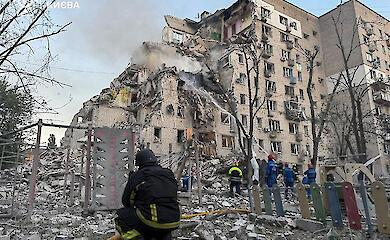

Ukrainians have to help wounded during Russian shelling on their own
