
El Niño has begun
- Home
- Events
- Natural disasters
- El Niño has begun


El Niño has returned. NOAA announced its onset on 11 June 2026, after sea surface temperatures in the central and eastern equatorial Pacific had remained at least 0.5 °C above normal for several months.
NASA satellites have detected another significant sign: in the central and eastern parts of the Pacific Ocean, sea levels have risen above normal. This is because warm water expands and causes the ocean to ‘rise’ slightly. Put simply, the Pacific Ocean has started to swell due to the heat.
For now, scientists are cautious in their predictions. The phenomenon is intensifying, but only further observations will reveal just how powerful it will become.
Details
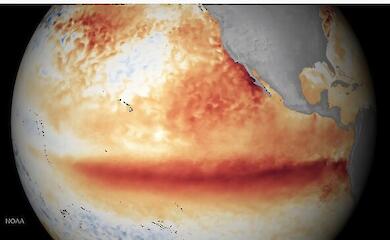
NASA has released a map of sea-level anomalies for 8 June 2026. Areas where the water level is above average are marked in red. Such zones have appeared in the central and eastern parts of the equatorial Pacific Ocean — precisely where El Niño usually develops.
The data was collected by the Sentinel-6 Michael Freilich satellite and processed by specialists at NASA’s Jet Propulsion Laboratory.
Sea surface height is just as important as temperature. If warm water is confined to a thin layer at the surface, the impact on the climate may be weaker. But if a large amount of heat has built up beneath the surface, this is a serious sign: such energy can alter atmospheric circulation and weather patterns in various regions of the world.
In the spring of 2026, the satellite had already detected the precursors to El Niño — the so-called Kelvin waves. These are huge waves of warm water that move from west to east across the Pacific Ocean and often appear before an El Niño event develops.
What is El Niño in simple terms
El Niño is a natural climatic phenomenon in which part of the equatorial Pacific Ocean becomes warmer than usual. This causes changes in winds, ocean currents and rainfall patterns.
Under normal conditions, the trade winds drive warm water towards the western Pacific. But when these winds weaken or temporarily change direction, the warm water begins to shift eastwards – towards the coast of South America. There, it suppresses the upwelling of cold water from the depths, and the ocean becomes warmer.
This shift can affect the weather far beyond the Pacific Ocean. NASA notes that El Niño can typically bring wetter conditions to the south-western United States and drought to the western Pacific region, for example in Indonesia and Australia.
Why does the satellite monitor sea level?
At first glance, it seems strange: to understand the ocean’s temperature, you need to look at the temperature rather than the water level. But warm water expands. Therefore, where the ocean has warmed more, its surface rises slightly.
Sentinel-6 measures the height of the ocean’s surface with high precision. This helps us to see not only the warm water on the surface, but also the hidden heat stored beneath it. It is precisely this heat that could influence the strength of a future El Niño.
By May 2026, the satellite had already detected a warm water mass off the coast of South America. According to JPL, sea levels near Peru were more than 15 cm above the long-term average by mid-May.
How strong will El Niño be?
There is no definitive answer yet. NASA scientists compared conditions in the western Pacific Ocean on 8 June 2026 with the situation during the same period in 1997, when a very strong El Niño later developed. However, in the eastern Pacific, the current event was lagging behind: by that date, fewer warm water waves had accumulated there.
At the same time, according to NASA, new warm water plumes continued to move eastwards, meaning that El Niño was still gaining strength. Whether it will match the 1997 event depends on oceanic processes over the coming weeks and months.
Why this matters
El Niño can alter rainfall patterns, intensifying heat in some regions and drought in others. In severe years, the consequences extend far beyond the tropical Pacific Ocean: crops, water resources, fisheries, energy and logistics are all affected.
However, for Europe and Ukraine, it is not possible to make a direct forecast based solely on the onset of El Niño. Its impact on our region is more complex and less pronounced than in the tropics, Australia, Indonesia, the west coast of South America and parts of the US. It is more accurate to speak of a global climatic factor that may influence temperatures, food markets and extreme weather events, but which does not provide a simple ‘this is what winter will be like’ scenario.
Background
El Niño is part of the ENSO cycle, which includes the warm El Niño phase, the cold La Niña phase and neutral periods. Such events occur irregularly and usually peak around the period from November to January. NASA emphasises that every El Niño is different, but strong events are almost always associated with a hot year and significant changes in rainfall in certain regions of the world.
This is precisely why scientists are closely monitoring not only sea surface temperatures but also the movement of warm water beneath the surface. The more heat accumulated in the ocean, the greater the chance that the event will be significant.
Source
Source: NASA Earth Observatory, article “El Niño Is Underway”, published on 18 June 2026. It uses data from the Sentinel-6 Michael Freilich satellite for 8 June 2026, processed by NASA JPL.
Additional source: NASA Jet Propulsion Laboratory, article on the observation of Kelvin warm waves by the Sentinel-6 satellite. JPL explains that such waves often appear several months before El Niño and help to track the build-up of heat in the Pacific Ocean.
Mykola Potyka has a wide range of knowledge and skills in several fields. Mykola writes interestingly about things that interest him.
Related news
El Niño is back – and could be the strongest in 70 years of records


The world is preparing for a new El Niño: what it could threaten with


The Pacific Ocean is signalling: El Niño could start as early as this year
Popular news

Russia has received new weapons from North Korea: which regions of Ukraine could be at risk


Henry VIII’s long-lost castle has been found inside another castle


Bones of ancient humans found on the seabed of the Taiwan Strait suggest they were up to 190 cm tall

News about war

An expert explains how Russia is changing its tactics for strikes on Kyiv


The UN has reported a sharp rise in the number of Ukrainian civilians killed as a result of the war