

Beauty in Wartime: A History of the Beauty Industry from World War II to the Present


War is destructive, it leaves a mark not only on the battlefields but also in everyday life.
World War II is often referred to not only as a time of heavy casualties and hardship, but also as a period that changed the approach to beauty and grooming. For what to do when not only soldiers but also the resources that usually serve as the backbone of the beauty industry go to the front?
Beauty during the war: arrows instead of stockings
During the Second World War, shortages also affected the beauty industry: the materials used to make tights and stockings were used to make parachutes, and cosmetics components were used as lubricants for machinery. Nylon, invented in the early 1930s, quickly gained popularity as the main material for stockings, but in 1941 it was actively used for military purposes, and women's legs were left bare. Silk also disappeared, as it was also used to make parachutes.


With the disappearance of these materials from the shops, women all over the world (except for the USSR, things were bad there and without war) were forced to improvise. Stockings became a luxury that could be afforded only on exceptional occasions.
Yes ingenuity will always find a way out! To look fashionable, women drew arrows on their legs to create the illusion of stockings. It may look strange at first glance - what stockings when there's a war?! But this trick shows how important beauty remained, even in the darkest of times.
It's also why women had to shave their legs (damn Hitler!), because before that the hair under the cloth was not visible, but here everyone is naked, there was no choice.
Other women looked for an alternative: they smeared their legs with tea (this became the prototype of self-tanner) to give them a light tan, and drew "seams" with an eye pencil to create the effect of those nonexistent stockings. One can only imagine how the ghostly sense of preserved femininity and grooming lifted the spirits during this difficult time.
Lipstick as a symbol of resilience
Lipstick became almost a sacred object during the war. Most cosmetics became a luxury, and many manufacturers began to scale back their products. However, lipstick, especially scarlet lipstick, remained a symbol of resilience and even patriotism. In Britain in 1941, Winston Churchill personally banned the production of lipstick on the grounds that it had a positive effect on women's morale.


America has even introduced special "military" shades harmonised with uniforms. The Besame brand launched Victory Red lipstick, advertised as a patriotic symbol. Who knows, perhaps each imprint of brightly coloured lips on a paper or napkin was for women a kind of accurate shot at the enemy who was approaching victory.
Beauty as protest!
That's not the only reason. The fact is that Hitler (it is inconvenient to write it with a capital letter) was categorically against make-up on German women. He was particularly adamant about red lipstick. He believed that this colour was unworthy of women of the highest race, it made them vulgar. As soon as the women of his opponents learnt about it, they decided to show this plump dictator who was the mistress of the planet. Everyone painted their lips, even those who didn't like make-up very much. It was as if they were throwing a female challenge to the aggressor: "Here I am, with red lipstick! And what will you do to me?


After the win, many women confessed that the red lipstick held their "cuckoo" tight. That's how beauty helped save the world.
Saving money as a new trend
The scarcity of materials forced women to invent new methods of self-care. Instead of missing conventional creams, they used more natural remedies such as petroleum jelly, coconut oil or olive oil. Interestingly, now that we have access to a plethora of remedies, natural products are still popular. Yes, Vaseline, once a cheap substitute for cream, is now a trendy beauty product.

The modern beauty front: the evolution of self-care
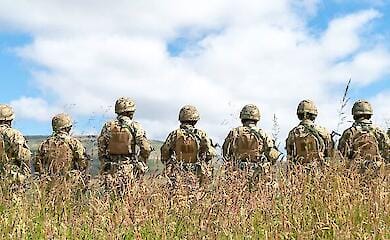
Today, war is once again plaguing our land, but even in such difficult conditions, we have much more freedom in our choice of grooming products. Nowadays, women who are on the front lines or supporting the front on the home front stay true to themselves and groom themselves even in the field.
If during the Second World War a woman had only lipstick and an arrow pencil, now you can see beauty kits in first aid kits, and advice about sustainable make-up for the trenches is no longer perceived as strange. In particular, Tatyana Chornovil recently shared her advice on convenient hairstyles for women at the front: braids and gathered hair allow you to quickly tidy up even in combat conditions, without interfering with the helmet, and without creating unnecessary problems while performing duties. And when you find flowers, you can also weave a wreath!


Permanent make-up and barbershops are at the forefront of the trend
One of the interesting trends of modern times is that many women choose permanent makeup as the best way to always look beautiful. Such makeup helps you feel confident even in the trenches, when the options for conventional makeup are limited. It is a kind of modern version of the same red lipstick, which once gave women a sense of control and their own power. Dainty arrows, lightly tinted eyebrows or shadow - these details help you feel like you're in control of something, it's just makeup.

Men are also looking for a way to maintain their style, and if there is even a brief respite, they are the first to head to barbershops or salons to get a haircut or beard trim. With limited access to grooming products, a haircut becomes more than just an option to keep up appearances, but a way to feel ready for any challenge. Barber shops, which continue to operate even in a war zone, have become a kind of place where the spirit is restored, allowing us to return to peaceful life, if only for a moment.

Beauty is evolving, and so is our relationship to it. It is no longer a luxury or a sign of wealth - it is part of our humanity, a small reminder of who we are and a symbol that even in the most difficult times we should not deprive ourselves of small pleasures. At first glance, it may seem that make-up or hair is a minor issue in times of war. But in reality, beauty and self-care can be a small island of normalcy that allows us to feel in control. It's a moment of self-expression, a way to remember that we're human, and a support for fortitude even in the most difficult of circumstances. The modern beauty industry is not only changing in the face of peace - it is also evolving in the face of military circumstances, showing that beauty will always find its place, even when the world is in chaos.
Even in war, there is a place for beauty. And we should see it. Otherwise, what's it all for?
Victory and peace to us!
Maria Grynevych, project manager, journalist, co-author of Guidebook Sacred Mountains of the Dnieper Region, Lecture Course: Cult Topography of the Middle Dnieper Region.
Related news
What to wear in 35 °C heat: stylists have named the fabrics that will help you cope better with high temperatures


How kings and bishops dressed: scientists recreate the clothes of ancient Nubia

Scientists have found a way to repair damaged hair with plant oils
Popular news

How to cook sweetcorn properly so that it’s juicy and sweet: the best method revealed

Archaeologists have discovered who actually built Colombia’s ancient canals

Russia has received new weapons from North Korea: which regions of Ukraine could be at risk

Bones of ancient humans found on the seabed of the Taiwan Strait suggest they were up to 190 cm tall

News about war
An expert explains how Russia is changing its tactics for strikes on Kyiv


The UN has reported a sharp rise in the number of Ukrainian civilians killed as a result of the war

