
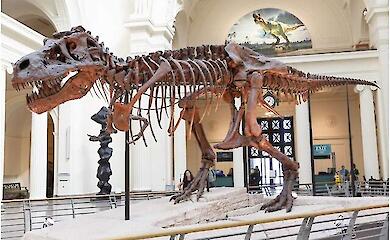

Plesiosaur remains found in Algeria for the first time - a rare find from the Cretaceous period


An ancient "sea lizard" found in Algeria
Palaeontologists have discovered for the first time in Algeria the remains of a plesiosaur, an ancient marine reptile that lived during the time of the dinosaurs. The find is not only important for the country: it belongs to a rare section of the Late Cretaceous period, from which very few similar remains are known worldwide.
The fragment was found in 2025 at the Jebel Essen site in the Tebessa region of north-eastern Algeria. This was no accident: the bone was picked up during a targeted survey of the Essen Formation rocks - as part of fieldwork related to the thesis research of one of the co-authors.
Only one vertebra was preserved - the central part of the dorsal vertebra. In the same layer, the remains of marine organisms: shells, ammonites and microfauna were found nearby. The researchers concluded that the bone was deposited in the conditions of a shallow lagoon on the shelf. The age of the layer was attributed to the Late Cretaceous (about 89-86 million years ago).
It is impossible to confidently name genus and species from a single vertebra, so the authors chose a cautious approach: they described the shape of the bone in detail and compared it with already known finds. According to key features, the specimen was attributed to plesiosaurs, and the most probable variant was called elasmosaurid - a group of "classic" plesiosaurs with a long neck and a small head.
Why this is important: plesiosaurs had been found in Northwest Africa before, but mostly from other intervals of the Cretaceous. There was very little data for this time, and none at all for Algeria. Now scientists have the first confirmed "anchor", which helps to more accurately reconstruct the map of the distribution of marine reptiles in the Late Cretaceous.
The team plans to continue excavations in the Tebessa area: look for additional bones in the same horizon (ideally skull and limb elements) and survey neighbouring layers to understand how widely plesiosaurs were represented in the region.
An independent researcher, interested in archaeology and sacred geography. He researches them and writes about them.
Related news
Henry VIII’s long-lost castle has been found inside another castle

A 2,500-year-old statue was found face down beneath an ancient road — it has been preserved almost in its entirety

In Japan, enormous vessels were used for everything from cooking to burial — scientists have uncovered their history
Mysterious symbols have been found on 9,000-year-old arrowheads — no one understands what they mean
Popular news
Archaeologists have discovered who actually built Colombia’s ancient canals

Russia has received new weapons from North Korea: which regions of Ukraine could be at risk

Henry VIII’s long-lost castle has been found inside another castle
Bones of ancient humans found on the seabed of the Taiwan Strait suggest they were up to 190 cm tall

News about war

An expert explains how Russia is changing its tactics for strikes on Kyiv


The UN has reported a sharp rise in the number of Ukrainian civilians killed as a result of the war

