

Scientists investigated whether giraffes can count — the result was surprising


Giraffes may be smarter than they seem. Scientists have investigated whether they are capable not only of seeing where there is more food, but also of mentally ‘adding’ up the quantities — almost as if they were doing simple addition.
Four giraffes from Barcelona Zoo were selected for the experiment. They were shown two portions of food; the containers were then covered, and food was added to only one of them. The animals then had to choose which container now contained more carrots, even though they could no longer see the final result.
The study was published in Scientific Reports.
The result was unexpected: in the ‘addition’ task, the giraffes chose the correct container more often than would be expected by chance. However, they were unable to cope with ‘subtraction’ tasks and more complex sequential tasks.
How the experiment was conducted
The idea was simple. Two containers containing different amounts of food were placed in front of the giraffe. The animal was shown for a few seconds how many carrots were in each container. The containers were then covered.
After this, the experimenter showed another container with extra food and added it to one of the covered containers. The giraffe could not see how much food was inside after the addition. It had to remember the initial quantities and work out which container should now contain more food following the change.
This is not counting in the human sense. The giraffes did not add ‘two plus one’ like schoolchildren. Rather, they kept an approximate quantity of food in mind and updated this information when they saw that something had been added to one of the containers.
Why this is similar to addition
Scientists call such tasks ‘quantity combination’. To put it very simply, the animal had to perform the following mental operation: ‘there was a little food there, more was added to it — so now there might be more there’.
Crucially, the giraffes could not simply choose a container based on its appearance, as the food was concealed. They could only see the initial portions and the fact that food had been added. Therefore, a successful choice suggests that the animals were able to mentally track changes in quantity.
On average, in the addition task, the giraffes made the correct choice in approximately 68 per cent of cases. This is above the chance level. However, in the task where food was removed, the result was around 57 per cent, and in the more complex task involving sequential changes — around 64 per cent; these results did not provide as clear a conclusion as the addition task.
But they cannot count in the same way as humans
It is important not to overinterpret this. The study does not prove that giraffes can count in the human sense or understand numbers as symbols.
Firstly, only four giraffes took part. This is a very small sample size. Secondly, the authors specifically note that only two animals consistently performed well even when they could not use a simpler strategy — for example, simply choosing the container that the experimenter had touched.
Why this surprised the scientists
Usually, such abilities are studied more often in humans, primates and birds. Ungulates — such as giraffes, deer, camels or hippos — are much less frequently included in such experiments.
But such skills may be useful to giraffes in the wild. They live in groups that may break up and reform, and food on the savannah is unevenly distributed. To search for leaves effectively and decide where to go, it may be important for the animals to assess where resources are more abundant.
Previous studies have already shown that giraffes can distinguish between quantities of food and even use statistical information when making choices. This new research adds another layer: giraffes can not only compare visible portions but also track how quantities change.
What didn’t work
Giraffes performed well on the task where food was added. But when food was removed, their performance was no better than random choice.
This is not surprising. Even for humans, subtraction is usually more difficult than addition. To understand ‘where there is less now’, one needs to retain more information in memory and update it more accurately after removal. In the experiment, the giraffes were unable to cope with this.
The task where food was first removed from one container and added to another proved even more difficult. Here, too, they failed to produce a consistent result.
Why this is important
The research helps us take a broader view of animal intelligence. Complex cognitive abilities may have developed not only in primates or birds, but also in other groups, if such skills aided survival.
Giraffes have long been perceived primarily through their unusual appearance: long necks, height, spots, and the savannah. But new experiments show that their cognitive abilities also deserve attention.
The authors of the study believe that such findings help us move away from an overly human-centred view of intelligence. Animals may solve problems differently to humans, but this does not mean that their solutions are simple or random.
Background
Animals often rely on an approximate sense of quantity. They need to understand where there is more food, how large a group of rivals is, and whether it is worth engaging in conflict or better to walk away.
In giraffes, such abilities may be linked to foraging. Their favourite leaves and trees are unevenly distributed across the landscape, so the ability to estimate the quantity of resources can be useful in everyday life.
This new study shows that even animals rarely associated with ‘mathematical’ thinking can solve quantitative problems better than expected.
Source
Study: Iker Loidi et al., “Assessing quantity combination and dissociation in giraffes”, Scientific Reports, 2026.
Maria Grynevych, project manager, journalist, co-author of Guidebook Sacred Mountains of the Dnieper Region, Lecture Course: Cult Topography of the Middle Dnieper Region.
Related news
People laugh, but cats are suffering: scientists have analysed popular pet videos

Scientists have unravelled the mystery of a fossil left in the Arctic almost 80 years ago

How dinosaurs took to the skies: a computer model has provided an unexpected answer
A single line in a 236-million-year-old bone changed the history of mammals
Popular news
How to cook sweetcorn properly so that it’s juicy and sweet: the best method revealed

Archaeologists have discovered who actually built Colombia’s ancient canals

Scientists have put forward an explanation as to why there were no tiny dinosaurs

Scientists have discovered how snakes lived during the age of the dinosaurs
News about war

An expert explains how Russia is changing its tactics for strikes on Kyiv


The UN has reported a sharp rise in the number of Ukrainian civilians killed as a result of the war


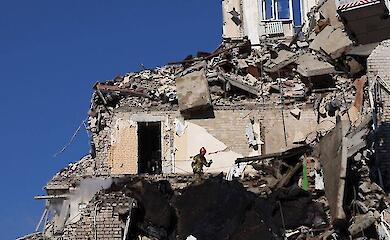
3 July has been declared a day of mourning in Kyiv. The number of dead and injured is rising