

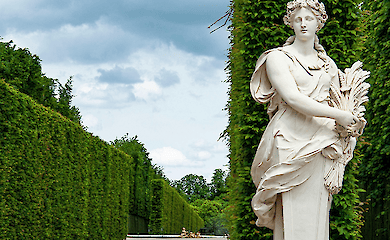
Why the ancient Romans loved public baths


Public baths (thermae) were one of the main elements of social life in ancient Rome.
As historian Peter Edwell writes in The Conversation, thermae served not only as a place to wash, but also as a centre of Roman social, entertainment and even political life.
By the fourth century AD, 952 public baths were functioning in Rome alone, and there were thousands of them throughout the empire. The largest thermae, built by Emperor Diocletian, could serve up to three thousand people daily. In addition to baths, there were gymnasiums, libraries, restaurants and open areas for recreation.
The author notes that typical Roman baths consisted of several rooms with different temperature regimes. First, visitors entered the caldarium, a hot room where the floor and walls were heated by special air ducts. Then they went to the tepidarium, a warm room, and finished the procedure in a cold room, frigidarium. Some baths also had sudatoria - analogues of modern saunas.
The philosopher Seneca, who lived above the thermae around 50 AD, described the bath atmosphere as follows: "One could hear the sighs and wheezes of those who lifted weights, the loud splashing of those diving into the pools, the shouts of salesmen and even the singing of those who simply enjoyed the process".
The thermae were frequented by people from all walks of life. Even the poorest could enter, and on holidays and political campaigns, entry was free. Wealthy visitors came accompanied by numerous servants, bringing expensive clothes and jewellery. There were separate areas or visiting hours for men and women.
According to the author, the Romans regarded the baths as a place that combined bodily and spiritual pleasures. A first century AD inscription on one of the baths read:
"Baths, wine and sex make life worth living."
However, behind the luxuries and pleasures there was also the hard work of slaves. They were responsible for keeping the baths clean, taking out the rubbish and serving the visitors. They washed their masters, rubbed their bodies with oil and cleaned their skin with special scrapers - strigils.
The tradition of public baths was not invented by the Romans, but it was they who made it truly mass. Roman thermae appeared in all corners of the empire: from Africa and Spain to Britain and Germany. Famous complexes have survived in the city of Bath (Aquae Sulis) in England, where the baths were powered by natural springs and dedicated to the goddess Minerva. In Germany, impressive ruins of baths are preserved in Baden-Baden, and in Spain, in Toledo, the complex covered almost a hectare.
Thermae were also an important part of life in military camps. For example, archaeologists have discovered baths along the famous Hadrian's Wall in Britain. These complexes provided relaxation and comfort for the soldiers who guarded the empire's borders.
Roman thermae had a huge influence on the culture of subsequent eras. During the Islamic period and especially under the Ottoman Empire, the tradition of public baths developed and transformed into modern Turkish hamams, of which there are now more than sixty in Istanbul alone.
The author believes that public baths were not just a place of hygiene, but a real social institution that united different classes, erased social boundaries and allowed Romans to enjoy life in all its manifestations.
"Today, standing among the ruins of the Thermae of Caracalla and listening to the cries of the seagulls, it is easy to imagine the noise and lively atmosphere of that time. Baths were an integral part of life, where physical pleasure was intertwined with culture, politics and social life," the researcher concludes.
An independent researcher, interested in archaeology and sacred geography. He researches them and writes about them.
Related news
Archaeologists have found children's fingerprints in 15,000-year-old clay

Traces of an "ancient machine gun" have been found in Pompeii
Scientists have found a huge bone from a possible ancestor of T. rex
Popular news

Orban announces "results" of Hungarian mission on Druzhba oil pipeline


Will maternity leave be shortened in Ukraine? Changes for workers with children


Zelensky said that Russia was preparing a new offensive and pointed out the direction of it


Kellogg named the ceasefire condition today and compared Putin to Nicholas II

News about war
Orban announces "results" of Hungarian mission on Druzhba oil pipeline
Kellogg named the ceasefire condition today and compared Putin to Nicholas II
Zelensky said that Russia was preparing a new offensive and pointed out the direction of it

Russia is destroying Ukraine twice as fast as at the start of the war - international report