

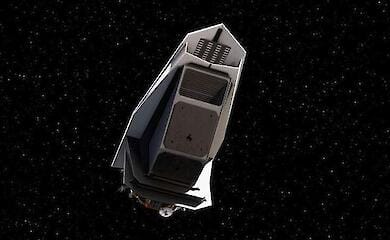
Traces of a meteorite that could have affected life on Earth have been found in Scotland


About a billion years ago, a giant meteorite crashed into north-west Scotland.
It sounds like a scene from a sci-fi film, but it's a scientific fact. And, as researchers have discovered, it happened 200 million years later than previously thought. The new impact age coincides with the emergence of some of the oldest terrestrial microbial communities on the planet.
This is according to a study published in the journal Geology.
The rock dossier for the disaster
Scotland's Torridon rocks are a veritable time capsule. They are layered rocks where billions of years ago there were lakes and rivers that were home to the oldest eukaryotes - microorganisms with a nucleus, the ancestors of all animals and plants.
But the quiet life of these microscopic inhabitants was disturbed by the fall of a meteorite, traces of which are preserved in a layer of rocks called Stac Fada Member. In it they found not only fragments and molten rocks, but also "signatures" of the impact: shock-altered minerals similar to those found at the site of the meteorite impact in Chicxulub (Mexico) - the same one that wiped out the dinosaurs.
Why is the new date important?
Using rare minerals including reidite and zircon, scientists were able to "set the clock" to the moment of impact. These minerals work like geological stopwatches: they only form at high pressure and temperature, recording the moment of the catastrophe. With the help of modelling, it was found that the impact occurred exactly 1 billion years ago.
This coincides with the epoch of the first terrestrial microbial communities and with the city-forming processes in the region. In other words, ancient life faced several global challenges at once - and survived.
A catastrophe that brought hope?
Although a meteor strike is a catastrophe, the aftermath may have played a role in evolution. Impacts of this magnitude not only destroy, but also create:
Cracks and hydrothermal vents,
Crater lakes that concentrate clays, phosphorus and organics - everything life needs.
New ecosystems in place of old ones.
In Scotland, a meteorite struck directly into an environment where microscopic life already lived. And thanks to amazingly well-preserved rocks, we can see how microorganisms survived the disaster and came back.
An alien legacy
This case shows that meteorites don't just leave dents in a planet - they can change the course of its biological history. They may have not only interrupted lives, but also kick-started new forms of existence.
Mykola Potyka has a wide range of knowledge and skills in several fields. Mykola writes interestingly about things that interest him.
Related news
Lost satellite 'brought back to life' after a month - scientists talk of a miracle



Popular news
Orban announces "results" of Hungarian mission on Druzhba oil pipeline

Will maternity leave be shortened in Ukraine? Changes for workers with children


Zelensky said that Russia was preparing a new offensive and pointed out the direction of it


Kellogg named the ceasefire condition today and compared Putin to Nicholas II

News about war
Orban announces "results" of Hungarian mission on Druzhba oil pipeline
Kellogg named the ceasefire condition today and compared Putin to Nicholas II
Zelensky said that Russia was preparing a new offensive and pointed out the direction of it

Russia is destroying Ukraine twice as fast as at the start of the war - international report