
Study: Jackson Pollock's abstract paintings are reminiscent of children's drawings


How "mature" does a work of art have to be to be considered a real painting and not a child's smear?
Can the paint patterns themselves distinguish the work of a famous artist from a child's drawing? A team of scientists from the USA has tried to answer these questions by analysing abstract "flood" paintings in the style of Jackson Pollock.
The authors of the work, published in the journal Frontiers in Physics, asked 18 children aged 4 to 6 years and 34 adults aged 18 to 25 years to recreate paintings in the style of Pollock. Participants in the experiment sprinkled diluted paint onto sheets of paper spread out on the floor. These age groups were chosen for a reason: children and adults have different balance systems and therefore different motor skills when "casting" paint.
The team, led by Professor Richard Taylor from the University of Oregon, applied fractal and lacunar analysis to the resulting works. Fractals are patterns that repeat at different scales; they are found both in nature (in tree crowns, clouds, mountain landscapes) and in works of art. Fractal dimensionality describes the complexity of such structures, and lacunarity describes the "patchiness" of the pattern, i.e. the distribution of gaps between clusters of paint.
The analysis showed that adult paintings contained a higher density of paint and wider trajectories of its movement - the conventional "frame" of the image. Children's works, on the contrary, were characterised by small patterns and a large number of gaps between spots. The trajectories of splashes in children were simpler, more one-dimensional and changed direction less often compared to the more complex and variable movements of adults.
An unexpected finding was the similarity of these patterns to Pollock's own paintings.
According to Taylor, the artistic patterns that children create, in terms of fractal characteristics closer to the works of Pollock than the paintings of adult participants in the experiment. This may be due to the peculiarities of biomechanical balance: in children and people with balance disorders, movements are less stable and predictable, which is reflected in the character of the lines.
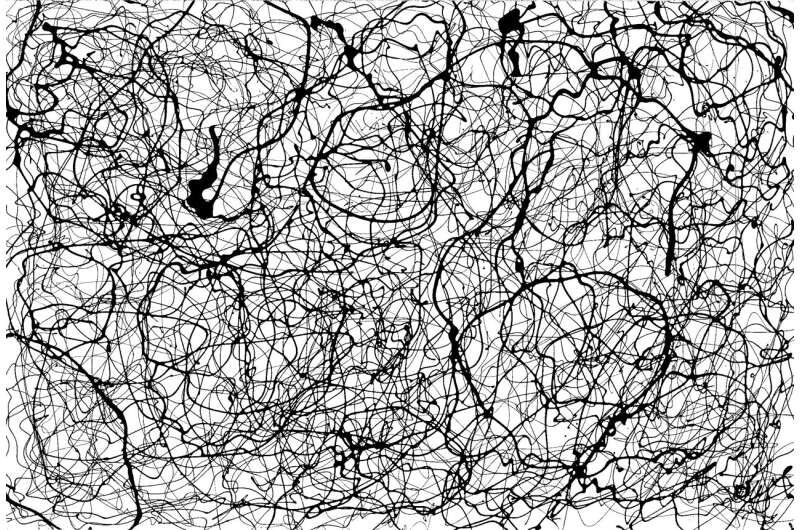
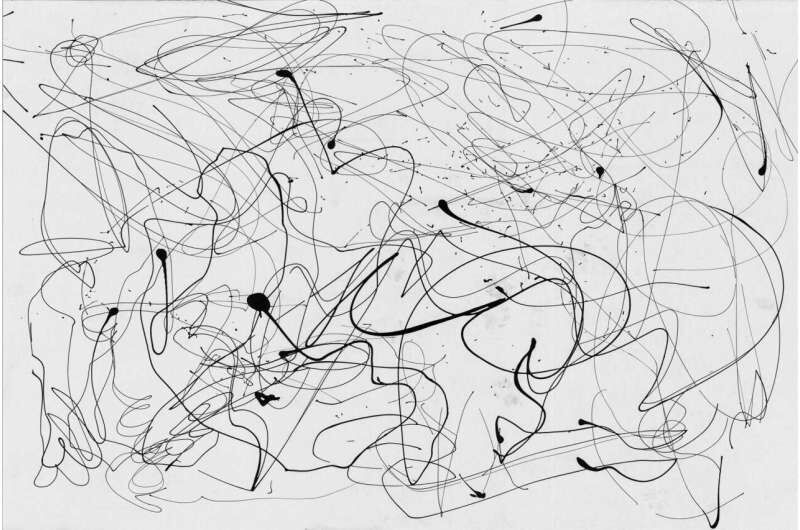
The study began back in 2002, then was interrupted and resumed in 2018, and now the team has summarised the results. The authors note that their findings are particularly relevant against the backdrop of rising stress levels in society following the COVID-19 pandemic. Fractal patterns have previously been linked to a calming visual effect: less complex fractals with more "air" are perceived by people as more pleasant. In the proportion of adult works analysed for complexity, interest and pleasantness, it was paintings with simpler fractal patterns and larger gaps between patches that seemed more appealing to observers. Children's artworks have similar characteristics, although their "pleasantness" was not assessed separately.
For comparison, the scientists also examined two works of expressionism, Jackson Pollock's "Number 14" and Max Ernst's "Young Man Intrigued by the Flight of a Non-Euclidean Fly." The fractal parameters of Ernst's painting fall within the range characteristic of children's works, which the authors attribute to the use of a pendulum that partially "muffles" the natural movements of the body. The fractal dimensionality of Pollock's "Number 14" fell within the adult range, but very close to the boundary with the childlike distribution - this is consistent with the limitations of its biomechanical balance discussed in art history.
According to Taylor, just as Claude Monet's cataracts, Vincent van Gogh's psychological problems, or Willem de Kooning's Alzheimer's disease influenced their artistic styles, Pollock's peculiarities of balance may have contributed to his unique abstract compositions. It is often the conditions that complicate everyday life that turn into sources of outstanding achievement in art.
Maria Grynevych, project manager, journalist, co-author of Guidebook Sacred Mountains of the Dnieper Region, Lecture Course: Cult Topography of the Middle Dnieper Region.
Related news

These microbes survive boiling water and acid - and could help save the Earth

100 years ago, the first rocket was launched - this was the beginning of the space age

Popular news
Orban announces "results" of Hungarian mission on Druzhba oil pipeline

Will maternity leave be shortened in Ukraine? Changes for workers with children

Zelensky said that Russia was preparing a new offensive and pointed out the direction of it


Kellogg named the ceasefire condition today and compared Putin to Nicholas II

News about war
Orban announces "results" of Hungarian mission on Druzhba oil pipeline
Kellogg named the ceasefire condition today and compared Putin to Nicholas II
Zelensky said that Russia was preparing a new offensive and pointed out the direction of it
Russia is destroying Ukraine twice as fast as at the start of the war - international report