

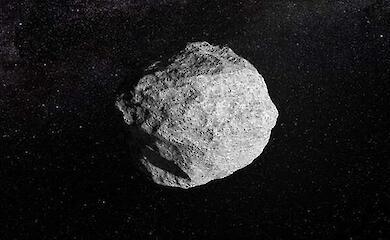
Scientists have discovered that the far side of the moon is colder than the near side of the moon


New rock samples from the Moon reveal the mystery of the "two-faced" Moon.
Scientists from University College London (UCL) and Peking University together with Chinese colleagues have concluded that the inner part of the far side of the Moon may be colder than the near side. This is stated in a study published in the journal Nature Geoscience.
The work is based on analyses of lunar soil samples delivered by China's Chang'e-6 spacecraft in 2024. The spacecraft collected about 300 grams of rock from a huge crater on the far side of the moon - the first samples obtained from this region. The scientists confirmed that the rock is about 2.8 billion years old and found that it formed from magma at depth at a temperature of about 1,100 °C - about 100 °C lower than similar samples from the near side of the Moon.
Professor Yang Li from UCL and Peking University said the differences between the near and far sides of the Moon have long been known, but their nature remains a mystery.
"We call it the two-faced Moon. The mantle temperature is believed to be lower on the far side, but this is the first time we have evidence from real samples," the scientist explained.
Peking University graduate student Xuelin Zhu added that the differences between the sides go much deeper than their surface. The far side of the moon has a thicker crust, more mountainous regions and craters, and appears less volcanically active than the near side.
Why the far side is colder
The authors of the paper suggest that the mantle of the far side was poorer in the elements that give off heat during radioactive decay: uranium, thorium and potassium. This could happen after a giant asteroid or planetesimali impact, which "stirred" the interior of the Moon and shifted the materials rich in heat-producing elements to the near side.
Other hypotheses also exist. For example, that the Moon may have collided with a "second small Moon" in early history, and the current samples of the two sides come from two different temperature bodies. Also discussed is the version that the near side heats up more because of the Earth's gravity.
How the study was conducted
Samples of lunar soil, mostly consisting of grains of basalt, were studied using an electron probe to determine composition. Scientists measured lead isotopes to date the rock using the uranium decay method.
The researchers then used several approaches to estimate the temperature at which the rock formed.
First, they analysed the mineral composition and compared it to computer models, finding that the crystallisation temperature was about 100 °C lower than that of the near-side samples.
They then estimated the temperature of the "parent rock" before it melted into magma, comparing the data with the results of the Apollo missions. The difference was again about 100 °C.
Additionally, the scientists, together with colleagues from Shandong University, used satellite data from the Chang'e-6 landing area, comparing it with similar data from the near side, and obtained a difference of about 70 °C.
On the Moon, heat-producing elements often coexist with phosphorus and rare earth elements in rocks rich in KREEP (from potassium - potassium, REE - rare earth elements, P - phosphorus). According to theory, these substances should have been evenly distributed during the formation of the Moon. But now they are concentrated in the near-side mantle, which explains its higher volcanic activity.
Although the study does not provide definitive data on the current temperature of the Moon's mantle, it confirms: the temperature imbalance between the sides could persist for billions of years, as the Moon cools extremely slowly. The team of scientists is already working on the following analyses to get a definitive answer.
Mykola Potyka has a wide range of knowledge and skills in several fields. Mykola writes interestingly about things that interest him.
Related news

Lost satellite 'brought back to life' after a month - scientists talk of a miracle




Popular news
Orban announces "results" of Hungarian mission on Druzhba oil pipeline

Will maternity leave be shortened in Ukraine? Changes for workers with children


Zelensky said that Russia was preparing a new offensive and pointed out the direction of it


Kellogg named the ceasefire condition today and compared Putin to Nicholas II

News about war
Orban announces "results" of Hungarian mission on Druzhba oil pipeline
Kellogg named the ceasefire condition today and compared Putin to Nicholas II
Zelensky said that Russia was preparing a new offensive and pointed out the direction of it
Russia is destroying Ukraine twice as fast as at the start of the war - international report