


Scientists have discovered that plants can count


Scientists have discovered that plants can keep track of the number of repetitive events in the environment. An experiment with a mimosa has shown that the plant can "remember" cycles of light and darkness and change its behaviour depending on their number.
The results of the study were published in the journal Cognitive Science.
At the centre of the study was the plant Mimosa pudica, known for its leaves that fold up when touched.
The scientists decided to test whether mimosa can respond not only to individual stimuli, but also to repeated events.
Details
In the experiment, the plants were placed in conditions of alternating light and darkness. First, they went through several identical cycles:
- 12 hours of darkness
- 12 hours of light.
After several repetitions, the plants began to move their leaves more vigorously before the supposed appearance of light, as if waiting for dawn.
But when the lights were never switched on one day, the response disappeared. This showed that the plants could respond specifically to the number of cycles repeated, not just the internal biological clock.
Why it matters
Scientists believe that plants can process information in a more complex way than previously thought.
Until now, it was thought that abilities such as learning or memory were only possible in organisms with nervous systems. However, plants don't have neurons, and yet they can still exhibit learning-like behaviour.
This discovery could change ideas about how living organisms process information.
Background
The bashful mimosa has long been used in scientific experiments. Its leaves fold quickly when touched, and close at night and open again in the morning.
A new study suggests that plants can not only respond to stimuli, but also remember the sequence of events.
Source
Peter M. Vishton, Paige Bartosh, Can Mimosa pudica Plants Enumerate Light Exposure Events?, Cognitive Science (2025)
Maria Grynevych, project manager, journalist, co-author of Guidebook Sacred Mountains of the Dnieper Region, Lecture Course: Cult Topography of the Middle Dnieper Region.
Related news



These microbes survive boiling water and acid - and could help save the Earth

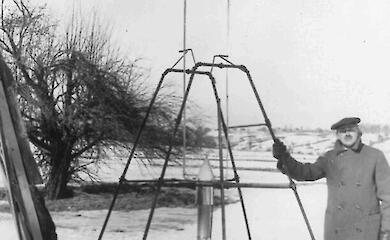
100 years ago, the first rocket was launched - this was the beginning of the space age

Popular news
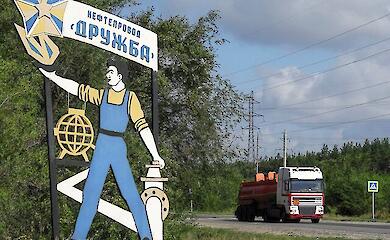
Orban announces "results" of Hungarian mission on Druzhba oil pipeline

Will maternity leave be shortened in Ukraine? Changes for workers with children


Zelensky said that Russia was preparing a new offensive and pointed out the direction of it


Kellogg named the ceasefire condition today and compared Putin to Nicholas II

News about war
Orban announces "results" of Hungarian mission on Druzhba oil pipeline
Kellogg named the ceasefire condition today and compared Putin to Nicholas II
Zelensky said that Russia was preparing a new offensive and pointed out the direction of it
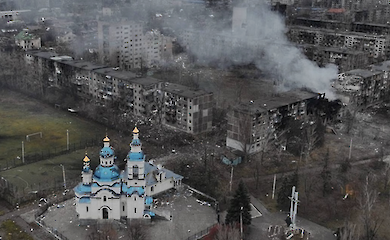
Russia is destroying Ukraine twice as fast as at the start of the war - international report