


President Zelensky showed F-16s on the day of the Ukrainian Air Force. What are they capable of?


Unofficial information appeared on 31 July, at the same time there were the first shots of the aircraft in the skies of Ukraine. Now the F-16 and Ukraine have been officially introduced
Ukraine received the first 10 F-16 fighter jets out of 79 on the last day of July. Ukraine should receive 20 aircraft by the end of 2024. The rest will arrive in batches during 2025.
What's worth knowing about them and what they can do.
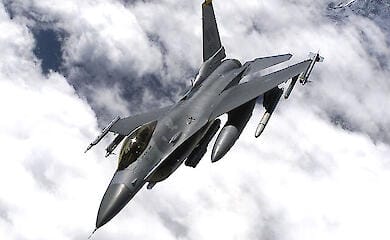
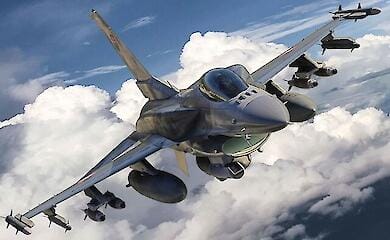
F-16 Fighting Falcon
Developed in 1974, entered service in 1978. Due to its versatility and relatively low cost is the most mass fighter of the fourth generation It is in service with 25 countries.
Despite the venerable age of the airframe itself, the F-16 electronics has been repeatedly modernised and is now a fairly modern complex of reconnaissance, capture and target engagement.
In fact, the modern combat aircraft is only secondarily designed for aerial combat, and in the first place it is used as a delivery vehicle - guided bombs (KABs) and air-to-ground missiles. By and large, a balloon can be used for this purpose, but a jet aircraft is still preferable. Therefore, despite some scepticism associated with its age and some lag in terms of technical specifications compared to modern Russian aircraft, the F-16 is a good platform.
With the development of jet aviation and countermeasures, all the armies of the world have come to the conclusion - no matter how manoeuvrable the aircraft is, it is not able to evade the missile. Therefore, all aerobatics figures, the same "Cobra", which are very effective looking, are simply meaningless. As well as the speed of Mach 2 or more, which the Russians are so fond of boasting about in their fighter characteristics. Practice has shown - the operating speed of a combat aircraft is no more than 800 km / h, ie only 0.65 Mach.
Therefore, the most important task became the ability to detect the enemy aircraft as early as possible and reach it with a missile. There are two ways to do this - reducing its "Effective Scattering Surface" (ESR), i.e. stealth technology, and increasing the range of radar and kill vehicles.
Of course, the F-16 will no longer change its EDS, it depends on the shape of the aircraft itself. But the range of radar and the range of air-to-air missiles - quite. This is the essence of its constant modernisation.
Russian propaganda convinces both themselves and us that their R-37 air-to-air missile will reach the F-16, so to speak, just over the horizon. The technical specifications of this missile quite allow to make such statements. Moreover, the defeat of our MiG-29 at a range of 213 km by Russian MiG-31BM was confirmed. In addition, Russian aircraft MiG-31BM, Su-35 can detect the target at a distance of up to 400 km. So, purely by dry figures, Russian aircraft can detect and destroy F-16 even close to the carriers of KABs.
But there is a nuance.
The fact is that Russian radars at such a distance can detect the aircraft if its EPR is 15 m², but the F-16 has an EPR of only 5 m²! Three times less than the calculated characteristics of radars. At the same time, all Russian aircraft have an EPR of at least 15 m².
The defeat of our MIG at a distance of 213 kilometres was possible thanks to the illumination of the Russian aircraft-radar A-50, which transmitted data to the interceptor MIG-31. And since the A-50s have recently stopped flying, this situation is unlikely to happen again.
At the same time, the F-16's capabilities are only increasing.
To begin with, together with the F-16s we are given two Saab 340 AEW&C radar aircraft, which can detect Russian aircraft at a distance of 450 kilometres. That is, Russian aircraft will be guaranteed to glow at a distance of 400 kilometres, while F-16s will not, not even at a distance of 130. Since the F-16's main means of reaching enemy aircraft is the AIM-120D missile with a range of 180 kilometres, this will suffice.
The F-16s handed over also have the latest infrared missile warning systems, as well as electronic warfare "jammers". This increases the chances of evading enemy missiles. The Saab 340 AEW&C also has the ability to lock on to land-based air defence radars, which will help the F-16 "take out" enemy air defences, making safe flight zones for itself.
So Russia simply doesn't have combat aircraft that are superior to the "old" F-16.

Eugenia Ruban writes about political and economic news. She looks at large-scale phenomena in Ukrainian politics and economics from the perspective of how they will affect ordinary Ukrainians.
Related news


Ukraine asked Biden to send those who could service F-16s to Ukraine, but he refused



Popular news
Orban announces "results" of Hungarian mission on Druzhba oil pipeline


Will maternity leave be shortened in Ukraine? Changes for workers with children

Zelensky said that Russia was preparing a new offensive and pointed out the direction of it


Kellogg named the ceasefire condition today and compared Putin to Nicholas II

News about war
Orban announces "results" of Hungarian mission on Druzhba oil pipeline
Kellogg named the ceasefire condition today and compared Putin to Nicholas II
Zelensky said that Russia was preparing a new offensive and pointed out the direction of it
Russia is destroying Ukraine twice as fast as at the start of the war - international report