

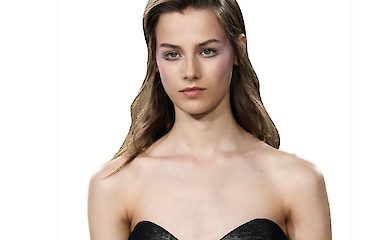
Preppy style, or "looking like you went to Harvard," is back in vogue


Preppies were once the uniform of the privileged - graduates of elite schools and universities, a code of "their own" in terms of money and access.
In 2025-2026, it's back at the centre of the fashion scene, but in a different role: as an open, reimagined and accessible visual language for all, according to a Harper's Bazaar article.
Preppy's return to the catwalk
The 2026 winter-spring season dramatically signalled a shift. The "quiet luxury" with its beige basics was replaced by a louder, more colourful and deliberately "college" style.
Michael Rider for Celine (spring-2026): American preppy 80s mixed with French bon chic, bon genre. Rugbies, argyle, striped ties and scarves, all in bright base colours rather than muted beige.
Jonathan Anderson for Dior Men (the first men's collection): the same codes - voluminous knitted jumpers thrown over the shoulders, chinos tucked into striped socks, loafers.

In Milan, at Versace Spring 2026, Dario Vitale joined the conversation:
oversize jackets with T-shirts, sports jackets with raised collar, striped waistcoats tucked into trousers, all in screaming colours.
this is not a copy of "academic" preppy, but a conscious dialogue with Gianni Versace's legacy and the queer culture that helped shape his aesthetic in the late 80s and early 90s.
Designers of the same generation (born around 1980-1984), raised on John Hughes, Princess Diana, the Sloane Rangers and the satirical The Official Preppy Handbook, are bringing back preppy, but without the "exclusivity".

Parallel:
Prada and Raf Simons (spring-2026) reinterpret the classic windbreaker logo,
Dior shows pastel polos with a crest,
Auralee, Willy Chavarria, Duran Lantink flip the preppy codes:
Chavarria - chicano versions of jackets and ties,
Lantink - spherical braids and tartans.
They all reference the same code, but look completely different.
How preppy became a symbol of both status and protest
Historically, preppy wasn't always the "boring uniform of the rich." Between the two world wars, Ivy League students took a British cut and mixed it with sportswear: Brooks Brothers suits plus letter jumpers, university paraphernalia.
"It was a pretty cutting-edge, even youthful style for its time," notes Patricia Mears, deputy director of the FIT Museum.
After the passage of the GI Bill in the 1940s, which opened up education to veterans, more students from non-wealthy families showed up on campuses. They mixed classic Ivy elements with more affordable ones - chinos, penny loafers, plain shirts.
For some, preppy meant access and status; for others, it was a way to demand respect.
In Black Ivy: A Revolt in Style, Jason Jules shows how Malcolm X, Martin Luther King, James Baldwin, Miles Davis, and other black figures of the 50s-60s borrowed the Oxford shirts and loafers of the WASP elite. It wasn't a desire to "become white," but a political gesture:
"It's not about the clothes, it's about the intention. You're wearing things that are 'out of place' for your class or race. You're crossing a line by wearing a form of privilege while being formally excluded from that privilege," says Jules.
Japan, Ralph Lauren and other "outsiders" who reinvented preppies
In the 1960s, Japanese entrepreneur Kensuke Ishizu sends a team out to take pictures of Ivy League students - thus the Take Ivy photo book. It launches a demand for Western preppie in a hitherto closed Japan. His VAN brand almost documents the Ivy wardrobe - and it is in Japan that the style survives and then returns to the US in a new form.
Many key figures in preppy culture are outsiders to the original WASP world:
Jacobi Press, founder of J. Press (1902), is a Jewish Latvian immigrant;
Ralph Lauren (born Ralph Lifshitz), the son of Jewish immigrants from the Bronx, by 1968 creating a brand that becomes almost synonymous with the preppy world.
Their success shows that a stylistic code invented by the elite works well in the hands of those who do not belong to this elite.

Preppy as a base for any style
That's the power of preppy: it's built on simple, straightforward things that are easy to reimagine:
button-down shirt,
loafers,
chinos,
polo,
trench coat.
The difference is in the styling: the way the sleeves are rolled up, the shirt is tucked in, the collar is turned up. Olympia Gayot, creative director of J.Crew, notes: the general things are the same, but everyone interprets them in their own way, and it is now that people are particularly keen on personal interpretation.
Designer Willy Chavarria recalls how in the '80s, preppy in his world was read through Chicano culture:
oversize Polo from the discounter,
pressed khakis,
perfect white sneakers.
In the '90s, preppies were actively tried on by hip-hop artists, making Tommy Hilfiger and Polo Ralph Lauren iconic.

So what makes a look "preppy"?
If preppies look different at Chavarria, Mrs Prada and Anderson, where is the boundary?
The code itself is not about the "right" people, but about things and symbols:
chinos,
polos,
waistcoats,
jackets,
trench coats,
university jumpers.
"The preppy story is partly a parody," says Chavarria. - "But the connection to it is held by the 'codes' themselves - the specific things. They are the ones that evoke associations with heritage."
For people of a different class or skin colour, preppy has often been the quickest way to visually connect to the American dream - and quietly redefine it at the same time.
Preppy as a democratic style
At its core, preppy is about ambition and transition:
between work and leisure,
between formality and relaxation.
Stylist Jalil Johnson sees preppy as a field for playing with gender and codes:
polo with low-heeled shoes,
a plaid shirt tied over a sequined skirt.
In these modern versions, preppie becomes truly democratic and truly American - reflecting a country made up of multiple identities and cultures.
"America is a conglomeration of cultures," Johnson says. - And preppy style is, too."
So who has the right to look preppie today?
Anyone.
Maria Grynevych, project manager, journalist, co-author of Guidebook Sacred Mountains of the Dnieper Region, Lecture Course: Cult Topography of the Middle Dnieper Region.
Related news




Popular news
Orban announces "results" of Hungarian mission on Druzhba oil pipeline


Will maternity leave be shortened in Ukraine? Changes for workers with children


Zelensky said that Russia was preparing a new offensive and pointed out the direction of it


Kellogg named the ceasefire condition today and compared Putin to Nicholas II

News about war
Orban announces "results" of Hungarian mission on Druzhba oil pipeline
Kellogg named the ceasefire condition today and compared Putin to Nicholas II
Zelensky said that Russia was preparing a new offensive and pointed out the direction of it
Russia is destroying Ukraine twice as fast as at the start of the war - international report