

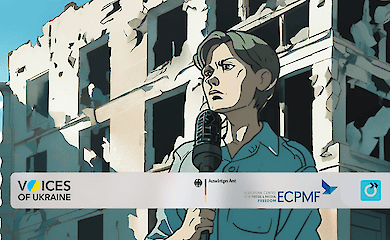
“How not to go crazy in captivity?”: the story of Ukrainian soldier and human rights activist Maksym Butkevych
- Home
- Special projects
- “How not to go crazy in captivity?”: the story of Ukrainian soldier and human rights activist Maksym Butkevych


This spring in Vienna, a meeting was held with Ukrainian human rights defender and former prisoner of war Maksym Butkevych. The event took place as part of a tour across the EU, during which Maksym shares his experience, communicates with local media, and reminds people of the importance of solidarity.
Butkevych is a well-known Ukrainian human rights defender. For decades, he has been a human rights activist, a co-founder of the NGO 'No Borders,' and one of the few people in Ukraine dedicated to helping asylum seekers, refugees, and foreign students facing injustice, mistreatment, and intolerance. He also assisted political refugees fleeing authoritarian regimes, primarily Putin's.
Maksym volunteered for the army at the start of Russia's invasion and was captured in the summer of 2022, spending over two years in captivity. In Russia, he was sentenced to 13 years on a fabricated case, which claimed he was an extremist leading a unit of ultra-right radicals. These accusations shocked everyone who knew Maksym and triggered the opposite reaction—numerous publications emerged about whom he really is.

Can a Human Rights Defender Be a Soldier?
I was dealing with Asylum Seekers, and refugees from Russia and I knew their situation I knew what they were flying from. I also was in touch with Russian human rights Defenders, real ones, so I knew pretty well the human rights situation in Russia. And I thought I knew what kind of Human Rights situation could be on the territories occupied by Russia, which is very simple — there would be no human rights because it is just not a part of 'Russian World' ideology, says Maksym, responding to whether there is a contradiction between human rights work and military service.
At the same time, he had almost no military training. At the university, where Maksym studied in the Faculty of Philosophy, the military department was merely a formality—in the 2000s, no one believed in the reality of a major war. However, he received an officer’s rank, so when he volunteered for the army, he was made a commander. Fortunately, he says, there were people in his unit with real military experience, while the rest had to learn the basics of warfare on their own.
We read manuals. We watched a lot of YouTube videos—you can find amazing things there. 'How to operate a rocket-propelled grenade launcher' was one of my favorites, Maksym laughs.
In reality, he constantly thought about how he could be truly useful, what he did best.
I tried in previous years to care about people and I had 20 guys under my command. And I thought well this is the role of the commander to care about my guys. And very soon everyone not only in my platoon but in all the neighboring knew ‘If you need something you should go to Moses’. 'Moses' was my call sign, Maksym says.
How Not to Lose Your Mind in Captivity
Butkevych and part of his unit were captured in the summer of 2022 in the Luhansk region. They were subjected to abuse, beatings, and humiliation. One intelligence officer beat Maksym with a stick and forced him to 'learn Ukrainian history' — by reciting one of Putin's speeches. According to Maksym, to avoid losing his mind, he invented his own prayers and, alongside them, satirical dystopias about imperialism. It was important for him not to forget English, so he taught his cellmates English, which, without textbooks or even paper, was, in his words, "an interesting experience." In his mind, he wrote columns for English-language publications and imagined giving speeches to English-speaking audiences.
So now this is this is what it is, Maksym jokes.
He also says that he often thought about the people he had met in his life. The thought of how many wonderful individuals he knew lifted his spirits.
If a guard had looked into my cell at that moment, he would have been surprised to see a gray-green, unshaven, and dirty prisoner of war smiling and been absolutely happy, he says ironically.
Maksym did not know he was about to be exchanged until the last minutes. He and another prisoner were ordered to pack their things and prepare for transfer. No one told them where they were going. Maksym assumed they might be sent to a hospital since the other soldier, who had survived torture, was in serious condition, and Maksym’s health had also deteriorated. Another possibility was being transferred to a colony in Russia. They didn’t want to think about an exchange to avoid disappointment.
At first, they were taken to another colony, where they joined a larger group of prisoners of war. Then their eyes were taped shut, and they were transported to an unknown location. Only the next day did they realize they were in Belarus, and soon after, they saw the Ukrainian border.
When we saw Ukrainian national colors and Ukrainian uniform we were happy. But I'm glad it did not come to me all at the same time, because it would be very difficult to manage. It came in waves and it was very nice, says Maksym.
Are Ukrainians Tired?
After Maksym’s speech, several painful for Ukrainian questions were raised. For example, whether Ukraine is currently experiencing a shortage of soldiers. Maksym noted that after three years of war, this has inevitably become a challenge. However, the situation is unlikely to be critical since the government has not introduced mandatory conscription from the age of 18 or mobilization for women, even though many serve in the Ukrainian Armed Forces voluntarily.
There is one more thing that might not be that visible - if the first stage of the full-scale invasion was primarily the war of artillery, currently we face the war of drones. Troops with less fighters but better technically equipped successfully resist and repel attacks of the enemy and even regain territories. It is a more high-tech war than any conflict before probably. Мilitary analytics are saying that we need more people, but we need more people not in the infantry, we need more people who are knowledgeable enough to operate equipment, in the first place it's about drones, Maksym adds.
When asked about Ukraine’s willingness to give up territories, he noted that reclaiming the 1991 borders is extremely difficult. But formally ceding occupied territories to Russia would be even more dangerous.
It would mean the end to what remains still of the European security system because basically, that means that one state can invade the neighboring country to take away part of its territory and get away with it. It would be the end of European and international law as we know it, Maksym emphasizes.
He also reminded that Russia’s goal is not just Crimea or Donbas but the complete subjugation of Ukraine. And millions of people who remain under occupation are fully experiencing this policy.
When asked how Russian prisoners of war are treated in Ukraine, Maksym noted that there have been documented reports by human rights organizations regarding cases of physical violence. However, international organizations have access to Ukrainian POW camps, can interview prisoners, and those responsible for mistreatment can be held accountable. Meanwhile, in Russia, the system is closed.
I cannot imagine officers of the High Commission of Human Rights visiting us in Russian detention, being able to talk to us about the conditions when we could say anything critical about Russia and surviving, says Maksym.
According to him, for Ukraine in this war, it is crucial not to turn into a ʼsmall Russia.ʼ However, Ukraine remains a democracy, and ʼour leaders are not Putin—they cannot do whatever they want.ʼ
The perspective currently are quite unclear in many ways, but I think we've done well, says Maksym.
Right now, Ukraine, in his words, is becoming the shield for all communities that want to live freely, in solidarity, and without fear. However, Ukrainian society is paying a huge price for this and needs support.
That’s why I’m here and trying to talk to everyone who wants to listen, and even some people who don't want to listen, says Maksym.
In the near future, he will visit more than a dozen European cities.
Expert on women's rights, persons with disabilities, motherhood in the modern context, health care reform, education and social welfare.
Related news
The loss of the middle class: what a new study on Ukrainian refugees showed

Kellogg named the ceasefire condition today and compared Putin to Nicholas II

Thousands of people will be able to receive assistance: how the law for Ukrainian critical infrastructure workers was changed

Zelensky spoke about Putin's kisses, politics and expectations
Popular news
Orban announces "results" of Hungarian mission on Druzhba oil pipeline


Will maternity leave be shortened in Ukraine? Changes for workers with children
Zelensky said that Russia was preparing a new offensive and pointed out the direction of it

Kellogg named the ceasefire condition today and compared Putin to Nicholas II
News about war
Orban announces "results" of Hungarian mission on Druzhba oil pipeline
Kellogg named the ceasefire condition today and compared Putin to Nicholas II
Zelensky said that Russia was preparing a new offensive and pointed out the direction of it
Russia is destroying Ukraine twice as fast as at the start of the war - international report