
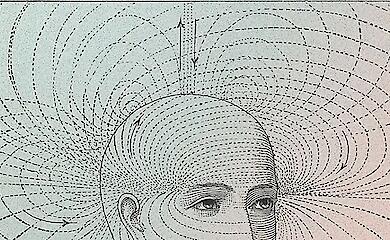


Over time, the details of the past often fade, but exactly how people explain what the event really was turns out to be remarkably resilient.
Researchers from Ben-Gurion University of the Negev came to this conclusion after studying so-called memory justifications - written and verbal explanations that a person gives when he or she recalls an episode and tries to "justify" its reality.
The team led by Talia Sadeh (along with doctoral students Avi Gamoran and Zohar Raz-Groman) notes that such "justifications" are not only important in everyday life. When we share memories, interlocutors often judge their credibility by how coherent and specific the explanation sounds - and in legal and investigative practice, this directly affects the credibility of testimony.
To test how time affects these explanations, the researchers recruited 421 participants aged 18-35. The test subjects performed recall tasks after a short delay (about a minute and a half) and after a long delay of 24 hours. In total, the researchers collected and analysed more than 4,000 written "memory justifications" using behavioural metrics and linguistic parsing of the text.
Expectedly, after 24 hours, people remembered less: access to memories was declining. But the key result was different: if a memory could still be retrieved, the accompanying explanation - why the person was sure it was real - remained almost the same as immediately after the task. According to the authors, the level of detail, vocabulary, and structure of justifications for "successfully retrieved" episodes did not noticeably sag over time.
The only consistent change was a slight increase in "safety net" language (words like "seems", "maybe"), i.e., an increase in hedging. However, this affected the manner of presentation rather than the semantic "stuffing" of the explanation. Moreover, the linguistic characteristics of the justifications themselves, according to the authors, were a better predictor of recall accuracy and reliability than participants' subjective confidence ("how sure am I that I am right").
In sum, the work supports an all-or-nothing model: either the recollection is retrieved along with a stable, coherent rationale, or it is not retrieved at all. This means that in situations where assessing certainty is important (e.g., in delayed testimony), asking for a written explanation of "why I remember this" may be more informative than asking for a simple confidence rating on a scale.
Maria Grynevych, project manager, journalist, co-author of Guidebook Sacred Mountains of the Dnieper Region, Lecture Course: Cult Topography of the Middle Dnieper Region.
Related news


Toxic people in your environment may accelerate ageing, study shows


Scientists show: working with childhood memories helps you fear failure less


Sometimes the brain itself is looking for something to distract itself with - scientists have explained why
Popular news
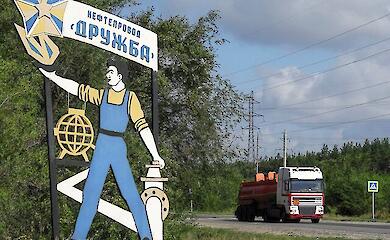
Orban announces "results" of Hungarian mission on Druzhba oil pipeline


Will maternity leave be shortened in Ukraine? Changes for workers with children


Zelensky said that Russia was preparing a new offensive and pointed out the direction of it

Kellogg named the ceasefire condition today and compared Putin to Nicholas II

News about war
Orban announces "results" of Hungarian mission on Druzhba oil pipeline
Kellogg named the ceasefire condition today and compared Putin to Nicholas II
Zelensky said that Russia was preparing a new offensive and pointed out the direction of it
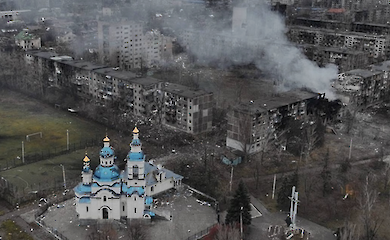
Russia is destroying Ukraine twice as fast as at the start of the war - international report