

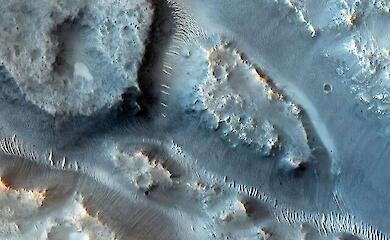
Astronomers have "seen" the explosion of a star in detail for the first time


Astronomers have for the first time obtained detailed images of two outbursts of new - explosions on the surface of stars - within days of their onset and traced how the structure of the matter ejections changes.
The results show: these phenomena are much more complex than thought, with multiple streams of ejected gas and, in some cases, a noticeable delay in the "resetting" of the shell.
The international team used the interferometry technique at the CHARA (Centre for High Angular Resolution Astronomy) array in California. By combining light from multiple telescopes, the astronomers achieved ultra-high angular resolution, enough to not just capture the flash as a point, but to literally "see" the shape and evolution of the explosion.
"These images give us a close-up view of how matter flies out of a star during an explosion," says Gail Schaefer, director of the CHARA array at the University of Georgia. Such short-lived events require flexible scheduling of nighttime observations to catch new objects in time, she says.
How a nova star explodes
A nova occurs when a white dwarf - a dense stellar "core" - accumulates matter from a companion star and triggers an uncontrolled thermonuclear reaction on its surface. Until recently, astronomers could judge the early stages of such explosions only indirectly: the expanding shell looked like a single unresolved light source in a telescope.
Understanding exactly how matter is ejected and collides is important for explaining shock waves in new ones. It is these, as data from the Fermi Space Telescope have shown, that become the source of high-energy gamma rays. In its first 15 years of operation, Fermi-LAT has detected GeV emission from more than 20 novae, making them important galactic gamma-ray sources and potential targets for multi-messenger astronomy.

Two different new - two explosion scenarios
In a new paper published in Nature Astronomy, scientists have studied two flares that occurred in 2021.
Nova V1674 Herculis was one of the fastest knownnovae: it flared brightly and faded quickly in just a few days.
In early images obtained by CHARA just 2.2 and 3.2 days after the outburst, the team saw two perpendicular streams of gas - a sign that the explosion was fuelled by several interacting emissions.
Remarkably, the appearance of these new streams coincided with the recording of gamma rays by the Fermi space telescope. This directly links shock-related processes to the collision of different streams of ejected matter.
The second flare, Nova V1405 Cassiopeiae, developed much more slowly. Unexpectedly, the star appeared to hold the outer layers for more than 50 days before finally shedding them. This is the first such clear observation of delayed shell ejection. When the matter did get ejected, shock waves formed again, accompanied by gamma rays recorded by Fermi.
"These observations allow us to observe the explosion of a star in real time," notes lead author Elias Aidi of Texas Tech University. - Instead of a simple flash of light, we see the complexity of the process. It's like going from grainy black-and-white photography to high-definition video."
Interferometry and the hidden structure of the explosion
The ability to see such fine detail was made possible by interferometry, the same technique that first imaged the black hole at the centre of our galaxy.
The resolved images from CHARA complemented spectra obtained at major observatories, including the Gemini telescopes. The spectral data showed how the "fingerprint" of the ejected gas changes with time. The appearance of new components in the spectrum coincided with the appearance of structures in the interferometric images, giving strong confirmation of the pattern of flow and flow collisions.
"This is a huge step forward," said co-author of the paper, University of Michigan professor and interferometric methods expert John Monnier. - 'The fact that we can now observe the explosion of a star and immediately see the structure of the ejected matter is truly amazing. It opens a new window into the study of the most dramatic events in the Universe."
What this means for stellar physics
The results not only reveal an unexpected complexity of new ones, but also help explain the origin of the powerful shock waves producing gamma rays. According to Professor Laura Homiuk of the University of Michigan, another co-author of the paper, novae are "more than just fireworks in our galaxy":
"These are extreme physics labs. When we see how and when matter is ejected, we can link the thermonuclear reactions on the surface of a white dwarf, the geometry of the ejection, and the high-energy radiation we detect from space."
The new data challenge the long-held view of a nova flare as a single, brief pulse. Instead, they point to a variety of ejection scenarios - from multiple streams to delayed envelope shedding - that are changing our understanding of these cosmic explosions.
"This is just the beginning," Aidy emphasises. - As observations like these accumulate, we may finally be able to answer the big questions about how stars live and die, and how they affect their surroundings. Novas that once seemed like simple flares are turning out to be much richer and more interesting than we thought."
Mykola Potyka has a wide range of knowledge and skills in several fields. Mykola writes interestingly about things that interest him.
Related news
Lost satellite 'brought back to life' after a month - scientists talk of a miracle

These microbes survive boiling water and acid - and could help save the Earth
Astronomers have discovered a mysterious source of signals in space
Popular news
Orban announces "results" of Hungarian mission on Druzhba oil pipeline

Will maternity leave be shortened in Ukraine? Changes for workers with children


Zelensky said that Russia was preparing a new offensive and pointed out the direction of it


Kellogg named the ceasefire condition today and compared Putin to Nicholas II

News about war
Orban announces "results" of Hungarian mission on Druzhba oil pipeline
Kellogg named the ceasefire condition today and compared Putin to Nicholas II
Zelensky said that Russia was preparing a new offensive and pointed out the direction of it
Russia is destroying Ukraine twice as fast as at the start of the war - international report