


A psychiatrist has explained how safe it is to talk politics at the festive table


Talking about politics is often a source of stress, especially around the holidays when relatives with different views gather around the same table.
In an increasingly polarised society, it's difficult to avoid such topics entirely, so it's important to understand how to talk about politics in a way that doesn't destroy relationships, explains psychiatrist Assim Shah of Baylor College of Medicine, according to Phys.org.
According to Shah, the first step is to consider the environment in which you're speaking out. This is especially true at work: boundaries are tougher in the office, and any phrases can be misunderstood and even affect your career.
"Everyone should be careful about what they say - especially in the workplace," he emphasises.
One key rule is listening. When talking to colleagues, friends or family, it's important to respect other people's positions and not "boil over" even if you disagree. The psychiatrist advises not to feel obliged to immediately defend their views: if a loved one expresses an opposite opinion, you can just listen and not try to change his mind.
"If we realise that we can't change the other person's views, the conversation becomes easier. Give everyone space and listen to all sides," says Shah.
He also reminds us of the importance of stopping in time. If an argument is getting more and more tense but not going anywhere, Shah recommends the three to five minute rule: if you feel the conversation is boiling over several times during this time, it's worth changing the subject or cutting off communication to avoid a serious argument.
"There's no point in risking the relationship," he emphasises.
In any environment - at home or at work - the conversation should remain mutual: if you're talking on your own, give others a chance to speak and calmly listen to their point of view. It's important to keep a respectful tone and not get personal.
If an argument breaks out in a company of several people, Shah suggests trying to act as a "moderator": acknowledge that you hear one side's arguments, offer to listen to the other and postpone the discussion - "sleep on it" to return to the topic later, when the heat has subsided.
Another common mistake is to be sure you're right from the start.
"Anyone who starts a political conversation thinks they're right - that's the problem," the specialist notes.
He urges not to throw insults, but, after hearing an unfamiliar fact, to slow down the pace of the conversation: to retell what you heard and say, for example: "I didn't know that, I'll have to look it up." And be sure to verify information with reliable sources.
Political stress is not a new phenomenon, but Shah says everyone has the ability to reduce it. Instead of trying to win an argument at all costs, it is better to practice respect, listen to your interlocutors and pause in time - this helps to keep both the party and the relationship alive.
Maria Grynevych, project manager, journalist, co-author of Guidebook Sacred Mountains of the Dnieper Region, Lecture Course: Cult Topography of the Middle Dnieper Region.
Related news


Toxic people in your environment may accelerate ageing, study shows


Scientists show: working with childhood memories helps you fear failure less


Sometimes the brain itself is looking for something to distract itself with - scientists have explained why
Popular news
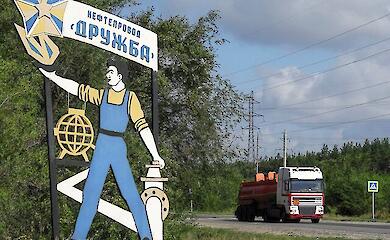
Orban announces "results" of Hungarian mission on Druzhba oil pipeline


Will maternity leave be shortened in Ukraine? Changes for workers with children

Zelensky said that Russia was preparing a new offensive and pointed out the direction of it

Kellogg named the ceasefire condition today and compared Putin to Nicholas II

News about war
Orban announces "results" of Hungarian mission on Druzhba oil pipeline
Kellogg named the ceasefire condition today and compared Putin to Nicholas II
Zelensky said that Russia was preparing a new offensive and pointed out the direction of it
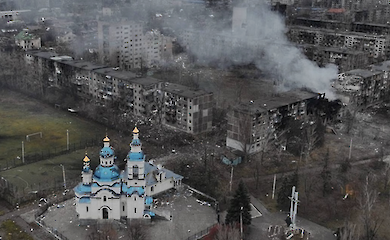
Russia is destroying Ukraine twice as fast as at the start of the war - international report