


2025 comes out as one of the three warmest years on record


the year 2025 is moving towards becoming the second hottest year on record, tying with 2023.
This was reported on Tuesday by the European climate monitoring service Copernicus, Euronews reports. The absolute record, according to preliminary estimates, for 2024.
The new Copernicus data confirms: global temperatures are steadily approaching and temporarily exceeding the threshold of 1.5 °C above pre-industrial levels, which the 2015 Paris Agreement labelled as more "safe" for the planet.
The service calculates that from January to November 2025, the average temperature was 1.48 °C above pre-industrial levels, which "puts 2025 on par with 2023 as the second hottest year on record".
"The average temperature over the three years 2023-2025 will be the first time the average temperature will go above the 1.5 °C mark," said Copernicus climate strategist Samantha Burgess.
She emphasised that these milestones are not abstract numbers:
"They reflect the accelerating rate of climate change. The only way to mitigate further temperature rises is to reduce greenhouse gas emissions rapidly and on a large scale".
Back in October, UN Secretary General António Guterres warned that the world would not be able to keep warming below 1.5 °C in the coming years.
Warm November and weather extremes
According to Copernicus, last November was the third warmest on record, some 1.54 °C above pre-industrial levels, with an average surface air temperature of 14.02 °C.
Such changes look like "tenths of a degree", but scientists warn: this is already enough to noticeably destabilise the climate and increase extreme events - storms, floods, abnormal downpours and droughts.
"The month is remembered for a series of extreme weather events, including tropical cyclones in Southeast Asia that caused widespread, catastrophic flooding and loss of life," the monitoring service notes.
In November, the Philippines was hit by two consecutive typhoons that killed about 260 people. Indonesia, Malaysia and Thailand faced severe flooding.
The global average temperature in the northern hemisphere for the autumn months (September-November) was also the third highest on record, behind only 2023 and 2024.
Temperatures were above normal in many regions of the world, especially northern Canada, over the Arctic Ocean and in Antarctica, while notable cold anomalies were noted in northeastern Russia.
Fossil fuels and the failure of climate ambitions
Copernicus generates estimates using billions of measurements from weather stations, ships, buoys and satellites, as well as model data since 1940. The trend is unambiguous: global temperatures are rising due to greenhouse gas emissions, primarily from burning coal, oil and gas since the Industrial Revolution.
In 2023, countries at the UN climate summit COP28 in Dubai agreed to transition away from fossil fuels. However, over the following year, climate ambitions slowed down markedly.
The COP30 climate conference in Belém, Brazil, which ended last month, registered an agreement that never included an explicit call for a phase-out of oil, gas and coal - fossil fuel-dependent states were opposed.
Against this backdrop, climate scientists warn, the 2024-2025 statistics are no longer a wake-up call, but a siren, showing that the window for keeping warming within "safe" scenarios is rapidly closing.
Mykola Potyka has a wide range of knowledge and skills in several fields. Mykola writes interestingly about things that interest him.
Related news

Arctic on the brink: how melting ice is accelerating the spread of pollution


How permafrost will react to global warming: scientists' predictions

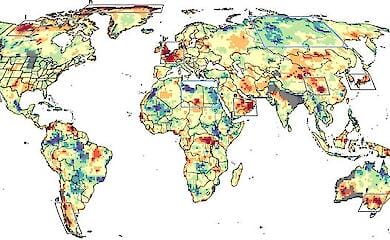
Thermal hotspots appearing around the world: scientists sound the alarm


Popular news
Orban announces "results" of Hungarian mission on Druzhba oil pipeline

Will maternity leave be shortened in Ukraine? Changes for workers with children


Zelensky said that Russia was preparing a new offensive and pointed out the direction of it


Kellogg named the ceasefire condition today and compared Putin to Nicholas II

News about war
Orban announces "results" of Hungarian mission on Druzhba oil pipeline
Kellogg named the ceasefire condition today and compared Putin to Nicholas II
Zelensky said that Russia was preparing a new offensive and pointed out the direction of it
Russia is destroying Ukraine twice as fast as at the start of the war - international report